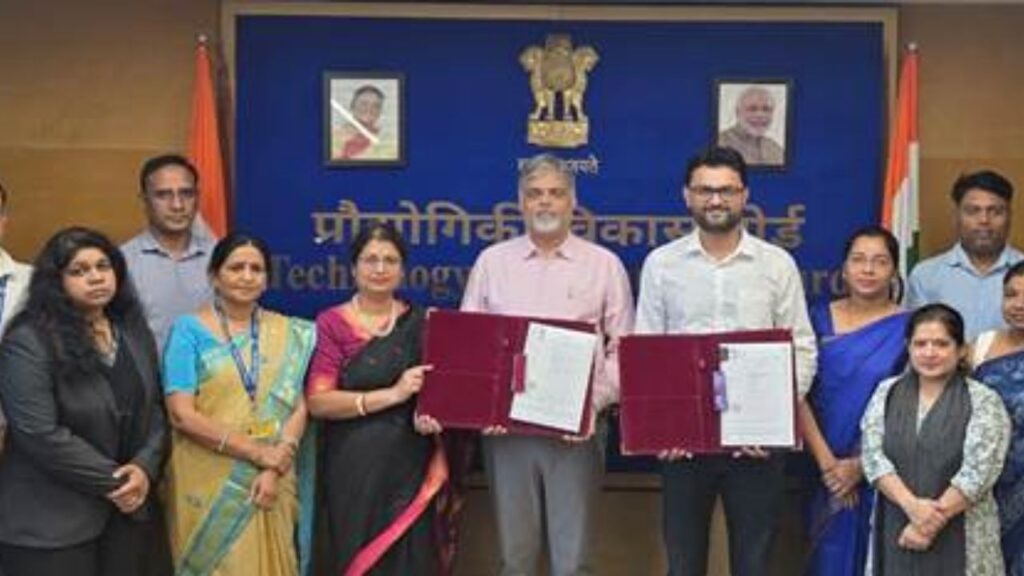

The Technology Development Board (TDB), under the Department of Science & Technology (DST), Government of India, has entered into an agreement with Nagpur-based Multi Nano Sense Technologies Private Limited to support the development of an indigenous advanced multi-gas sensing platform. Under the agreement, TDB will provide financial assistance of ₹37.51 crore through the Research Development and Innovation (RDI) Fund.
The project has a total approved cost of ₹75.02 crore and aims to advance the technology from Technology Readiness Level (TRL)-4 to TRL-9, representing a transition from an early-stage validated technology towards a fully developed and commercially deployable solution. The financial assistance will be extended through an Optionally Convertible Debt (OCD) mechanism.
Multi Nano Sense Technologies is developing a Platform MEMS + AFE SoC Multi-Gas Sensor based on an indigenous MEMS TCDIR gas sensor and a CMOS Application-Specific Front-End System-on-Chip (AFE SoC). The platform combines miniature sensing hardware with specialised electronics for acquiring, processing and interpreting gas-related signals.
The technology is being developed to provide reliable and scalable gas detection in a compact form. Its potential applications cover a wide range of industrial and emerging technology sectors, including refineries, petrochemical facilities, power systems, PNG infrastructure, industrial safety, battery technologies and the hydrogen economy.
A key feature of the proposed platform is the integration of a MEMS-based gas sensing element with a customised AFE SoC. This architecture is intended to provide high sensitivity while keeping power consumption low and enabling intelligent signal processing. Such capabilities could be particularly useful in applications where continuous monitoring, rapid detection and compact sensor designs are required.
The sensor platform is also being designed for operation in challenging industrial environments and across a broad temperature range. It incorporates features such as automatic calibration, compensation for environmental conditions and software-based gas-library processing. According to the project objectives, the system is expected to achieve a response time of less than 200 milliseconds, supporting applications that require quick identification of gas-related changes or leaks.
The compact design is another important aspect of the technology. The proposed sensor package is targeted to remain below 25 mm × 25 mm × 15 mm. This small form factor could enable integration into embedded systems and battery-operated devices, expanding the range of possible applications beyond conventional industrial monitoring equipment.
The RDI Fund-supported programme will cover further technology development, system integration, testing, validation and scale-up. The ultimate objective is to take the platform to TRL-9 and establish a pathway towards large-scale deployment.
The project has been classified under the Deep Technology sector, with Quantum Technology identified as the sub-sector. The development brings together multiple technology areas, including Micro-Electro-Mechanical Systems (MEMS), semiconductor electronics, gas sensing and intelligent signal processing.
Speaking about the initiative, TDB Secretary Rajesh Kumar Pathak said that sensors form the foundation of several modern technology systems and that strengthening domestic capabilities in sensing and semiconductor technologies is important for industrial competitiveness and strategic self-reliance. He added that the RDI Fund is intended to support technologies that need sustained development before achieving wider commercial deployment.
A representative of Multi Nano Sense Technologies said that the RDI support would help the company advance its MEMS gas-sensing technology through further integration, validation and scale-up. The company aims to develop a compact, low-power and scalable multi-gas sensing platform capable of meeting demanding requirements across multiple industries.
The initiative highlights the growing importance of indigenous sensor and semiconductor technologies in industrial safety, energy infrastructure and emerging applications. By supporting the transition of the platform towards TRL-9, the project seeks to strengthen India’s domestic capabilities in advanced sensing technologies and contribute to the development of market-ready deep-tech solutions.
Also Read: MSME Ministry and MoSPI Sign MoU to Strengthen Statistical Business Register

Author: Shivam
Proficient Writer Contact: [email protected]