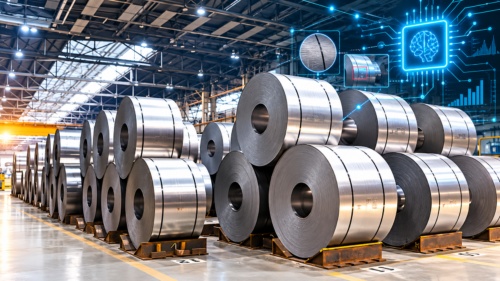
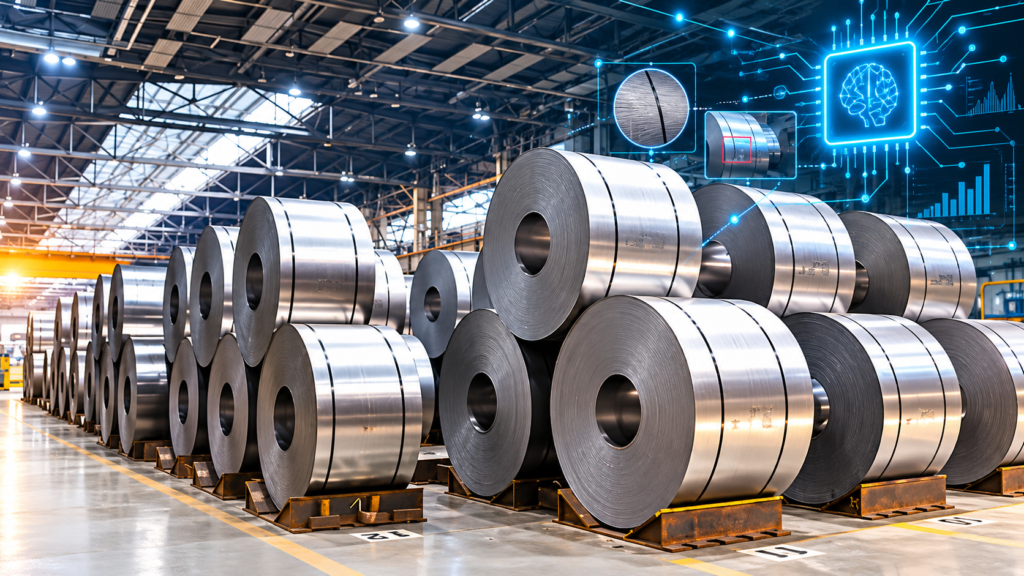

Steel Policy: India’s proposed National Steel Policy Vision 2047 aims to strengthen domestic steel manufacturing through artificial intelligence (AI)-powered import monitoring, stricter quality checks, and targeted trade measures to tackle sub-standard steel imports and unfair trade practices.
The draft policy, released for stakeholder consultation, calls for a comprehensive import governance framework that combines testing, certification, product traceability and real-time data analytics. The objective is to identify unusual import patterns at an early stage, protect domestic manufacturers from non-compliant products and improve the competitiveness of India’s steel industry.
AI and Data Analytics to Strengthen Import Surveillance
The proposed framework places greater emphasis on the use of AI and advanced analytics to detect sudden increases in imports, the entry of steel that fails to meet prescribed standards, and possible attempts to circumvent trade protection measures.
The draft states that the government will continue to take measures to discourage the import of low-quality and sub-standard steel. These efforts will include AI-assisted import monitoring and other appropriate trade remedies. At the same time, the policy seeks to encourage exports of high-quality Indian steel.
The proposed measures form part of a broader strategy built around three priorities: quality assurance, fair trade and the development of domestic manufacturing capabilities.
New Policy to Address Changing Industry Requirements
The draft National Steel Policy Vision 2047 is intended to provide a long-term roadmap for the sector, taking into account emerging technologies, changing market conditions and the need to reduce avoidable dependence on imports.
The government considers a review of the National Steel Policy 2017 necessary in view of the evolving challenges facing the industry. Artificial intelligence, machine learning, technological modernisation and improvements in manufacturing efficiency have emerged as important priorities for the next phase of growth.
Alongside plans to expand India’s steelmaking capacity to 604 million tonnes (MT), the proposed policy highlights raw material security, technology adoption and stronger quality control as key areas for investment.
Trade Remedies to Address Unfair Competition
The draft notes that more than 60 per cent of India’s steel imports come from countries with which it has free trade agreements (FTAs). Meanwhile, growing protectionism in global steel markets has prompted several countries to introduce measures against low-priced imports, unfair trade practices and supply chain disruptions.
To address such concerns, the policy proposes pursuing evidence-based anti-dumping duties, countervailing measures and safeguard actions wherever unfair trade practices are established. These interventions would be coordinated with the Directorate General of Trade Remedies (DGTR), the Department of Commerce and other relevant stakeholders.
However, the draft also stresses that trade measures should be proportionate and targeted. Domestic steel producers need protection from unfair competition, but downstream manufacturers must continue to have access to essential steel inputs at competitive prices.
The policy further recognises that India will need to import certain specialised and value-added steel grades that are not sufficiently available from domestic producers.
Reducing this dependence will require sustained investment in advanced metallurgical technologies, automation, research and development, quality management, productivity, energy efficiency, raw material availability and logistics infrastructure.
Steel Trade Surplus in FY26, but Imports Rise in the Current Fiscal
India’s recent steel trade performance underlines the importance of balancing domestic capacity expansion with import management.
According to the draft policy, India was a net exporter of finished steel in FY2025-26. Imports declined by 32 per cent to 6.5 million tonnes, while exports rose by 36 per cent to 6.6 million tonnes during the financial year.
The trend has since shifted. Official data cited in the draft show that India imported finished steel worth ₹36,193.9 crore during April–August of the current financial year, leaving the country a net importer over the period.
Finished steel imports reportedly increased by 29.5 per cent to approximately 3.49 million tonnes during April–August, compared with approximately 2.69 million tonnes in the corresponding period of FY2025-26.
China, South Korea, Japan, Indonesia and Vietnam were identified as the five major sources of finished steel imports during the period.
Domestic Competitiveness Remains the Central Objective
The proposed policy seeks to go beyond import restrictions by addressing the structural factors that influence the competitiveness of Indian steel manufacturers. Stronger quality standards, improved technology, secure raw material supplies and efficient logistics are expected to play a central role in building a more resilient industry.
The emphasis on AI-led surveillance reflects the government’s intent to make import regulation more data-driven and responsive to changing trade patterns. If implemented effectively, the framework could help identify non-compliant imports more quickly while ensuring that legitimate demand for specialised steel is not disrupted.
The draft National Steel Policy Vision 2047 is currently open for stakeholder consultation, with its proposals intended to guide the long-term development of India’s steel industry.
Read More-MSME Ministry and MoSPI Sign MoU to Strengthen Statistical Business Register