
Nepal India Agriculture Cooperation:- Nepal PM Balen Shah’s India Visit to Focus on Fertilizer Supply, Green Urea Plant and Agriculture Cooperation
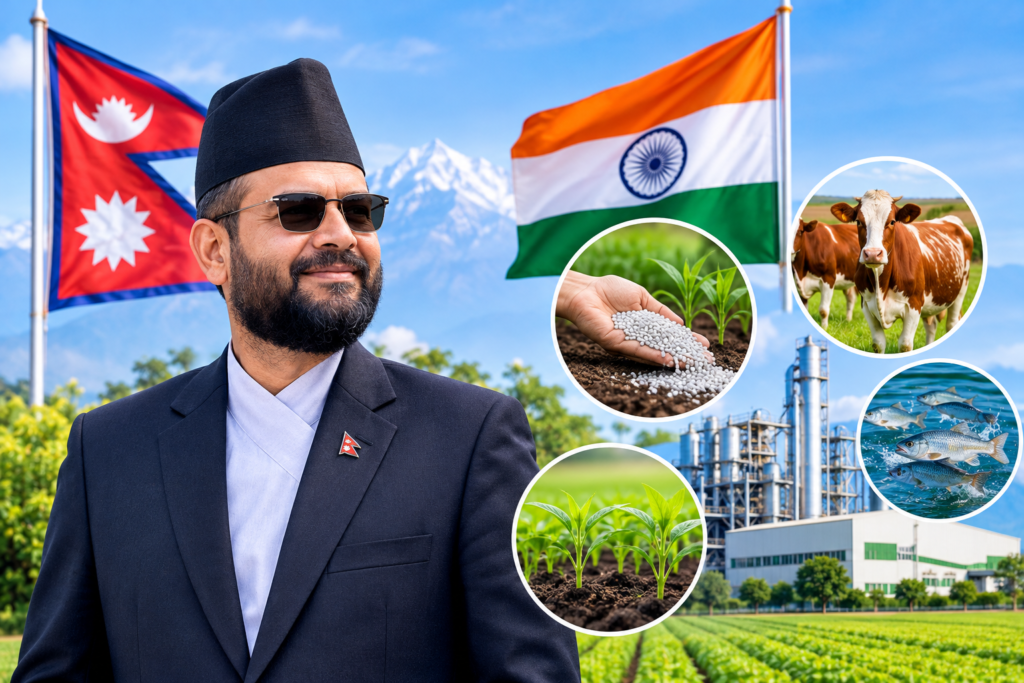
Kathmandu: Nepal is preparing to strengthen agricultural cooperation with India during Prime Minister Balendra Shah’s (Balen Shah) proposed visit in the second week of Mangsir. Fertilizer supply, green urea production, livestock development, fisheries and agricultural research are expected to be among the key topics of discussion.
Although Nepal’s Cabinet is yet to give formal approval to the visit agenda, the Ministry of Agriculture has completed its initial preparations and submitted several proposals to the government.
According to a senior ministry official, Nepal may also sign a Memorandum of Understanding (MoU) with India to promote cooperation in livestock and fisheries development. Discussions are also expected on improving access to chemical fertilizers, quality seeds and modern agricultural technology.
Nepal India Agriculture Cooperation:- Nepal and India May Sign MoU on Livestock and Fisheries
Strengthening cooperation in livestock and fisheries is one of the major proposals prepared by Nepal’s Agriculture Ministry.
Officials are working towards a possible agreement between the two countries to support development in these sectors. The proposed MoU could provide opportunities for sharing technical knowledge, improving livestock production and strengthening fisheries activities.
The ministry has already submitted its recommendations for the Prime Minister’s visit. However, the final agenda and the participation of agriculture ministry officials in the delegation will be confirmed after Cabinet approval.
The ministry is also expected to decide whether a senior secretary-level official will join the visiting team.
Nepal India Agriculture Cooperation:- Chemical Fertilizer Supply a Major Priority
Chemical fertilizer availability remains a major concern for Nepalese farmers. Nepal is expected to raise this issue during discussions with India.
According to the Agriculture Ministry, the previous agreement between Nepal and India on chemical fertilizer cooperation has expired. Both countries may therefore discuss a fresh MoU to improve fertilizer supply and ensure better availability for farmers.
However, it is not yet confirmed whether the new agreement will be signed during the visit or whether the two sides will hold discussions for future cooperation.
Apart from fertilizers, Nepal is also looking to strengthen agricultural research partnerships with India. Better access to quality seeds, improved crop varieties and agricultural genetic resources is another important area under consideration.
Agricultural product trade and market-related issues may also be included in the broader discussions between the two countries.
Nepal India Agriculture Cooperation:- Nepal Plans to Explore Green Urea Fertilizer Production
Along with improving fertilizer imports, Nepal is considering the establishment of a domestic chemical fertilizer manufacturing plant.
The Agriculture Ministry is exploring the possibility of developing a fertilizer factory based on green technology, with greater participation from private investors.
The government is giving priority to green urea production as an alternative to conventional fertilizer manufacturing that depends on fossil fuels.
The proposed project is also connected to the government’s 100-point programme and its broader policy priorities.
Cooperation with India may help Nepal access technical expertise, investment opportunities and knowledge required to develop green fertilizer production facilities.
Nepal India Agriculture Cooperation:- Government Seeks Investment Proposals for 500,000-Tonne Green Urea Plant
To assess the feasibility of the proposed fertilizer factory, Nepal’s Agriculture Ministry has invited companies and potential investors to submit their concepts and project proposals.
The ministry wants to understand the investment requirements and technical details involved in producing approximately 500,000 metric tonnes of green urea annually.
The information being collected includes:
- Estimated investment required to establish the factory.
- Production costs and expected price per unit of fertilizer.
- Experience of companies and investors in fertilizer manufacturing.
- Land and infrastructure requirements.
- Government support and incentives needed by investors.
- Suitable models for ownership and factory operations.
The ministry is also seeking suggestions on possible government incentives, including land availability, customs duty exemptions and income tax benefits.
These details will help the government understand the financial and operational requirements before moving towards implementation.
Nepal India Agriculture Cooperation:- Government to Consider PPP and Private Investment Models
Nepal is considering different options for developing and operating the proposed fertilizer manufacturing facility.
The government may examine three possible models:
- Government ownership: The fertilizer factory could be established and operated by the government.
- Public-private partnership: The government and private investors could jointly develop and manage the facility.
- Private-sector investment: A private company could establish and operate the factory with suitable government support.
The final model will be selected after reviewing the proposals and studying the investment requirements.
The project is currently at an early stage, with the ministry collecting information and assessing available investment opportunities. According to the official, the next phase of implementation may be handled by the Ministry of Industry or Nepal’s Investment Board, depending on the government’s decision.
Nepal India Agriculture Cooperation:- India-Nepal Cooperation Could Support Agricultural Growth
Nepal’s proposed India visit could open new opportunities for cooperation in fertilizer production, agricultural research, livestock, fisheries and seed development.
For Nepal, improving fertilizer availability and developing domestic production capacity are important steps towards reducing dependence on imports and supporting farmers.
The proposed green urea project could also encourage private investment and promote cleaner fertilizer manufacturing technologies.
If the plans move forward, stronger cooperation between Nepal and India could support agricultural productivity, improve fertilizer security and create new opportunities for sustainable farming and agribusiness.
The success of these initiatives will depend on the outcome of bilateral discussions, government approvals, investment interest and the development of practical implementation plans. Source:- Ratopati