
PFAS Pollution in England:- PFAS Pollution Falls in England’s Rivers and Fish, New Report Highlights Progress Against Forever Chemicals
London, UK: England has recorded a significant decline in the levels of two harmful chemicals, PFOS and PFOA, in its rivers and freshwater fish over the past decade. A new report by the Environment Agency says stronger regulations, government action and restrictions on chemical use have helped reduce pollution caused by these substances.
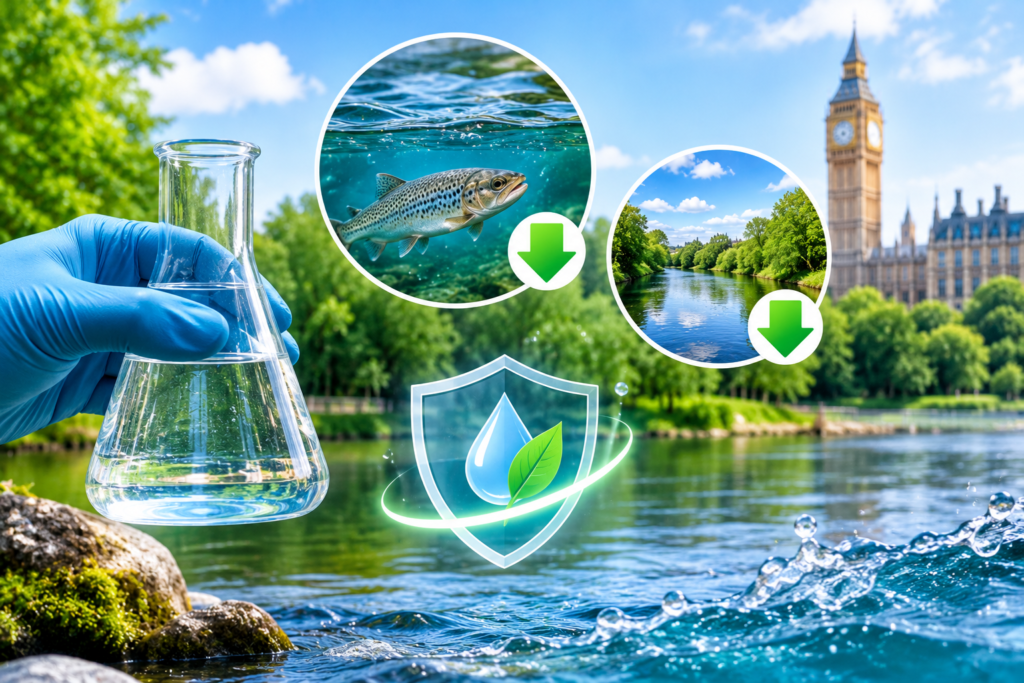
According to the latest report, levels of PFOS in England’s rivers decreased by around 30% between 2016 and 2025, while PFOA levels fell by 29%. PFOS concentrations in freshwater fish also declined by approximately 49% during the same period.
The findings indicate that environmental regulations and targeted pollution control measures can help reduce the presence of harmful chemicals in water bodies and aquatic ecosystems.
PFAS Pollution in England:- What Are PFAS or Forever Chemicals?
PFAS, also known as per- and polyfluoroalkyl substances, are a large group of chemicals used in various industrial processes and everyday products.
These chemicals are commonly called “forever chemicals” because many of them take a very long time to break down naturally. Some can remain in the environment for hundreds of years and gradually accumulate in soil, water, wildlife and living organisms.
PFOS and PFOA are two well-known types of PFAS that have raised environmental and public health concerns because of their persistence and potential harmful effects.
PFAS Pollution in England:- PFOS and PFOA Levels Show Significant Decline
The Environment Agency’s latest report, titled PFAS Sources, Pathways & Environmental Data, provides an updated assessment of these chemicals across England.
It builds on the agency’s 2021 assessment and includes a much larger collection of environmental samples, along with improvements in testing and monitoring technology.
The report highlights the following changes between 2016 and 2025:
-
PFOS in rivers: Decreased by approximately 30%.
-
PFOA in rivers: Declined by around 29%.
-
PFOS in freshwater fish: Fell by approximately 49%.
These reductions suggest that restrictions on certain older PFAS chemicals are producing measurable environmental benefits.
However, the report also warns that PFAS pollution remains widespread because of their long history of use and continued releases from some sources.
PFAS Pollution in England:- UK Government Strengthens Action Against Forever Chemicals
The latest findings will support the implementation of the UK’s first national PFAS Plan, introduced by the government earlier in 2026.
The plan aims to improve understanding of where these chemicals originate, how they move through the environment and how human and environmental exposure can be reduced.
The government is focusing on stronger monitoring, improved regulations and the development of safer alternatives to products containing PFAS.
Dr Robert Bradburne, Chief Scientist at the Environment Agency, said that scientific understanding of PFAS has improved considerably since 2021.
He explained that advanced testing methods now allow researchers to identify a wider range of chemicals more accurately. While the decline in older PFAS substances is encouraging, he stressed that further action is needed to control pollution.
Environment Minister Emma Hardy also welcomed the report’s findings, highlighting the government’s efforts to strengthen rules, improve monitoring and encourage safer alternatives.
PFAS Pollution in England:- Experts Call for More Research and Pollution Control
Environmental experts believe the decline in PFAS levels is an encouraging development, but they warn that the problem is far from over.
Dr David Megson, Reader in Chemistry and Environmental Forensics at Manchester Metropolitan University, said the latest report demonstrates the progress made in monitoring and reducing older PFAS chemicals.
He highlighted the importance of collecting environmental data from thousands of samples to identify areas with high pollution levels.
He also welcomed the use of advanced testing techniques, including total PFAS measurement and non-targeted analysis. These methods can help scientists detect emerging chemicals and identify potential pollution risks before they become more serious.
Experts believe that better monitoring will help authorities identify pollution sources and take action against those responsible for environmental damage.
PFAS Pollution in England:- UK Plans Wider Monitoring of Water and Land Pollution
Under its PFAS Plan, the UK government and the Environment Agency are working to expand environmental monitoring and improve pollution control.
Some of the major proposed measures include:
-
Increasing testing of estuaries and coastal waters.
-
Developing safer alternatives for water-resistant clothing and footwear.
-
Improving public awareness about PFAS pollution.
-
Preparing updated guidance for industries and environmental regulators.
-
Addressing historical PFAS contamination on polluted land.
-
Examining possible restrictions on PFAS use in firefighting foams.
-
Strengthening regulations on persistent organic pollutants.
The Environment Agency is also expanding its monitoring programme to cover rivers, lakes, groundwater, estuaries, coastal waters and landfill leachate.
The programme will examine a wider range of PFAS, including newer chemicals and substances that can break down into more concerning PFAS compounds.
PFAS Pollution in England:- Why PFAS Pollution Matters for Agriculture and the Environment
PFAS contamination is an important concern for agriculture because polluted water and soil can affect natural ecosystems, wildlife and agricultural resources.
Contaminated water may create risks for aquatic organisms and could also become a concern where it is used for irrigation or other agricultural activities.
Reducing the spread of these chemicals is therefore important for protecting water quality, soil health, biodiversity and sustainable food production.
The latest decline in PFOS and PFOA levels in England shows that environmental regulations and regular monitoring can make a difference.
However, continued research, stronger pollution controls and safer industrial alternatives will be necessary to prevent further contamination.
The Environment Agency plans to expand its scientific research into airborne PFAS monitoring, water quality thresholds and potential chemical replacements. These efforts will help guide future environmental policies and target pollution control measures more effectively.
The latest report offers encouraging progress in the fight against forever chemicals, but continued action will be essential to protect water resources, wildlife, agriculture and public health. Source:- Global Culture