
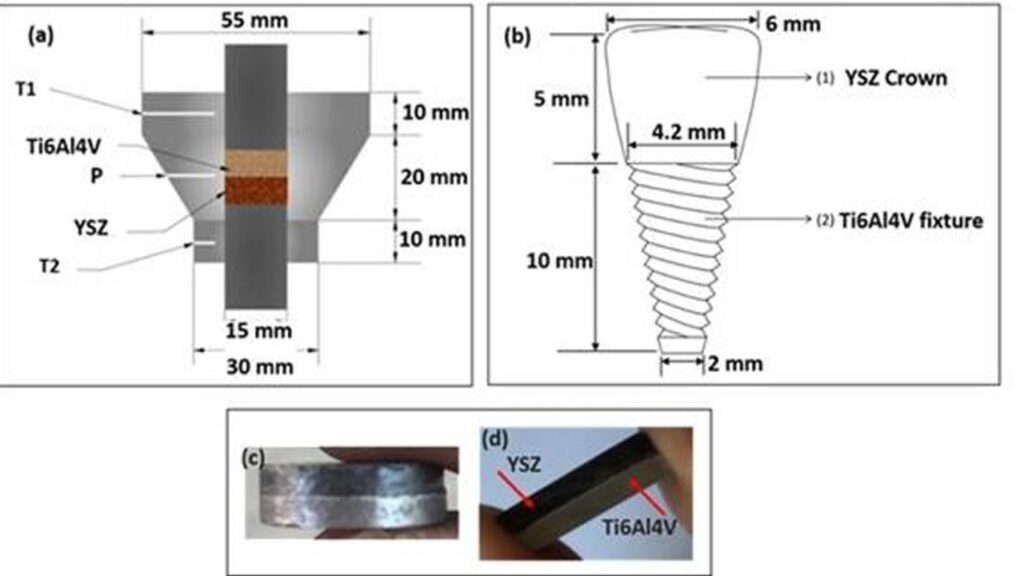

Researchers at the International Advanced Research Centre for Powder Metallurgy and New Materials (ARCI), an autonomous institute under the Department of Science and Technology (DST), have developed an innovative bi-layered dental implant that combines titanium alloy and zirconia in a single integrated structure. The technology is aimed at improving implant durability, interfacial stability and biocompatibility while reducing the complexity associated with conventional dental implant surgeries.
Addressing Limitations of Conventional Dental Implants
Conventional dental implants generally comprise three separate components: a fixture anchored into the jawbone, an abutment that connects the fixture to the crown, and the crown itself. The interfaces between these components can experience micromovements, potentially affecting the integration of the implant with the surrounding bone and increasing the risk of loosening over time.
The multi-component design can also require two or three surgical interventions, adding to treatment complexity, recovery time and patient discomfort. While titanium alloys and zirconia are established materials in dental applications, both have certain limitations when used independently.
Ti6Al4V, a titanium alloy commonly used for implant fixtures, provides mechanical strength and supports bone integration but can face corrosion-related concerns in the oral environment. Zirconia offers excellent aesthetics and corrosion resistance, but prolonged exposure to moisture can cause hydrolytic degradation, potentially affecting its long-term performance.
Single Integrated Metal-Ceramic Architecture
The ARCI research team has addressed these challenges by developing a functionally integrated bi-layered structure consisting of Ti6Al4V and yttria-stabilized zirconia (YSZ). The design assigns each material a specific role according to its functional properties.
The titanium alloy forms the load-bearing portion of the implant, providing the mechanical strength required for integration with the jawbone. The YSZ layer forms the crown region, offering high wear resistance and improved aesthetic characteristics that are particularly important for dental applications.
The researchers fabricated the structure using Spark Plasma Sintering (SPS), an advanced powder metallurgy process. A specially designed tapered graphite die enabled controlled heating during sintering and facilitated the simultaneous densification of Ti6Al4V and YSZ, despite the significant difference between their respective sintering temperatures.
High Density and Stable Interface
The manufacturing process produced a material density of around 99.5%, resulting in a dense and defect-free bi-layered structure in a single processing step. Following sintering, researchers used a five-axis computer numerical control (CNC) machine to conduct machining trials and manufacture the threaded implant geometry.
Some difficulties were encountered in guiding the cutting tool along the implant’s curved surfaces. Researchers are currently working on process optimization to address these machining challenges.
Microscopic and structural investigations showed a distinct and strongly bonded interface between the titanium alloy and zirconia. Importantly, the interface exhibited no cracks, delamination, pores or secondary phases. The YSZ grains were found to be extremely fine, measuring approximately 0.3 micrometres, while Ti6Al4V grains close to the interface were refined to around 0.3–1 micrometres.
The absence of significant elemental diffusion across the interface further indicated the formation of a stable ceramic-metal transition zone.
Strong Mechanical and Biological Performance
Mechanical testing demonstrated promising performance from the bi-layered material. The structure recorded hardness values of up to 1,350 HV, compressive strength of approximately 1,550 MPa and flexural strength of about 310 MPa. These properties are comparable to, and in some cases exceed, those associated with commercially available implant materials.
Biological testing also produced encouraging results. In vitro studies found the material to be non-cytotoxic and highly biocompatible. MTT assays using L929 mouse fibroblast cells recorded metabolic activity above 90% at all tested concentrations, indicating favorable cellular compatibility.
Hemolysis testing additionally showed negligible damage to red blood cells, providing further evidence of the material’s suitability for biomedical applications.
Potential for Scalable Dental Manufacturing
By bringing load-bearing strength, wear resistance, corrosion resistance, aesthetic performance and biological compatibility together within a single-piece architecture, the ARCI-developed implant could help address several limitations associated with conventional multi-component dental systems.
The technology also has the potential to reduce the number of surgical interventions required during implant placement, thereby simplifying treatment and potentially improving patient comfort and outcomes.
Researchers believe the highly reproducible fabrication process could eventually support industrial-scale manufacturing. The development represents a significant step towards indigenous production of advanced dental implants and could contribute to India’s efforts to make high-performance biomedical devices more accessible and affordable.
Also Read: India, Luxembourg Explore Deeper Cooperation in Space, AI and Quantum Technologies

Author: Shivam
Proficient Writer Contact: [email protected]