
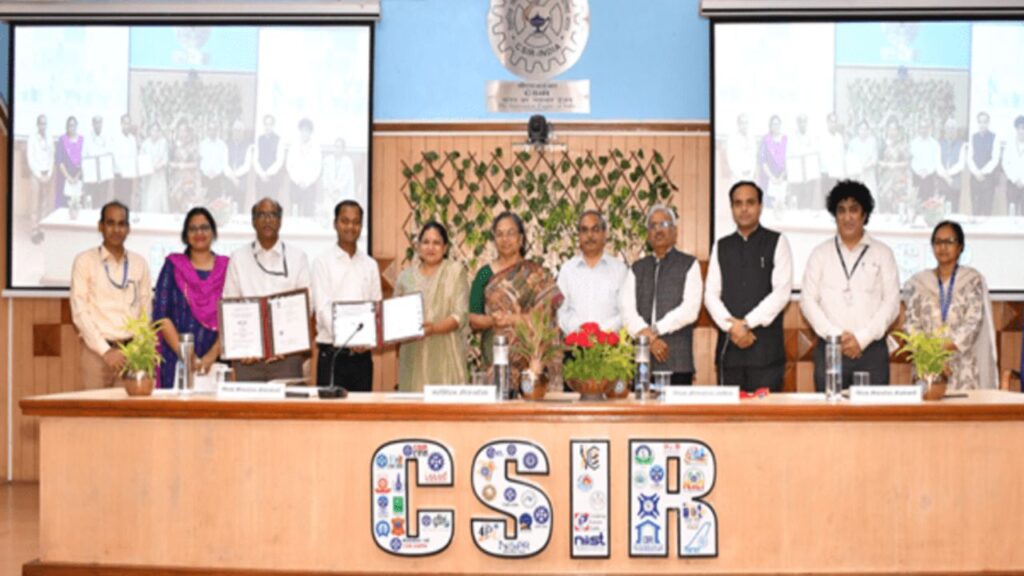

The Council of Scientific and Industrial Research (CSIR) has strengthened its commitment to translating scientific research into commercially viable products by transferring four indigenous technologies to industry, launching a smart rural water monitoring solution, and highlighting significant royalty earnings from defence technology commercialization.
The Technology Transfer Event, held at the CSIR Headquarters in New Delhi, brought together scientists, industry representatives, technology adopters and strategic stakeholders. Organized by the CSIR-Central Scientific Instruments Organisation (CSIR-CSIO), Chandigarh, the event showcased the growing collaboration between public research institutions and Indian industry in advancing indigenous technologies.
Four Indigenous Technologies Handed Over to Industry
A key highlight of the programme was the transfer of four homegrown technologies developed by CSIR-CSIO to industry partners for commercial deployment.
Three technologies—Induction Motor Stethoscope (MSCOPE), Portable and Universal Motor-cum-Pump Performance Monitor (PU-MPPM), and i-Power Quality Analyser (IPQA)—were licensed to Pump Academy Private Limited, Bengaluru. These technologies are expected to improve the monitoring, maintenance and efficiency of industrial motors and pumping systems, supporting better operational performance across sectors.
In another major transfer, the Optical Module and Beam Combiner Assembly for the Head-Up Display (HUD) used in the SU-30 aircraft programme was licensed to Bharat Electronics Limited (BEL), Panchkula. The technology is expected to further strengthen India’s indigenous defence manufacturing capabilities and reduce dependence on imported systems.
Smart Water Monitoring System Launched
The event also marked the commercial launch of an affordable Internet of Things (IoT)-enabled Water Service Delivery, Measurement and Monitoring Sensing System for rural deployment.
The system has been commercialized through Biometry Technologies Pvt. Ltd., New Delhi, and is designed to enable real-time monitoring of water quality, water quantity and service delivery in rural areas. By providing continuous data on water supply performance, the technology aims to support better management of rural drinking water infrastructure while improving transparency and service efficiency.
The launch reflects CSIR‘s growing focus on developing technologies that address both industrial and societal challenges through digital innovation.
Growing Technology Commercialization Ecosystem
Providing an overview of the laboratory’s commercialization efforts, Prof. Shantanu Bhattacharya, Director of CSIR-CSIO, highlighted the institution’s expanding innovation ecosystem and its increasing engagement with industry.
He noted that the successful transfer of multiple technologies demonstrates CSIR-CSIO’s emphasis on moving laboratory innovations into the marketplace. According to him, strategic partnerships with industry have played an important role in accelerating technology adoption while generating value for both the research ecosystem and manufacturing sector.
Prof. Bhattacharya also emphasized that the laboratory continues to strengthen its technology transfer mechanisms, ensuring that innovations developed through public-funded research contribute directly to national development.
Defence Technologies Generate Strong Royalty Income
One of the significant announcements during the event was CSIR-CSIO’s receipt of ₹1.67 crore as royalty from Bharat Electronics Limited during the financial year 2025-26.
The royalty was earned through the licensed production of several indigenous military avionics technologies, including the Head-Up Display (HUD), Drogue Lights, Taxi Landing Lights, HUD Level Tester and Boresight Alignment Tool.
The achievement reflects the successful commercialization of advanced defence technologies developed within the CSIR system and highlights the growing confidence of Indian defence manufacturers in indigenous research and development capabilities.
Officials noted that sustained industry partnerships are helping transform scientific innovations into products that support national security while contributing to the country’s self-reliance objectives.
CSIR Chief Stresses Industry-Oriented Research
Addressing the gathering, Dr. N. Kalaiselvi, Director General of CSIR and Secretary, Department of Scientific and Industrial Research (DSIR), congratulated the CSIR-CSIO team for its achievements in technology development and commercialization.
She praised the laboratory’s efforts under the leadership of Prof. Bhattacharya in expanding industry collaborations, increasing external cash flow and enhancing technology transfer activities.
Dr. Kalaiselvi emphasized that successful commercialization of indigenous technologies remains central to CSIR’s mission of converting scientific research into products and processes that generate value for industry while delivering meaningful benefits to society.
She encouraged scientists across the CSIR network to continue pursuing research that addresses national priorities, supports industrial growth and contributes to the vision of an Atmanirbhar Bharat through innovation-driven solutions.
The event concluded with a vote of thanks by the Head of the Business Development Group (BDG), CSIR-CSIO, marking another milestone in CSIR’s efforts to bridge the gap between laboratory research and industrial application. Through sustained technology transfer and industry partnerships, the organization continues to reinforce India’s innovation ecosystem while promoting self-reliance in critical sectors such as defence, manufacturing and rural infrastructure.

Author: Shivam
Proficient Writer Contact: [email protected]