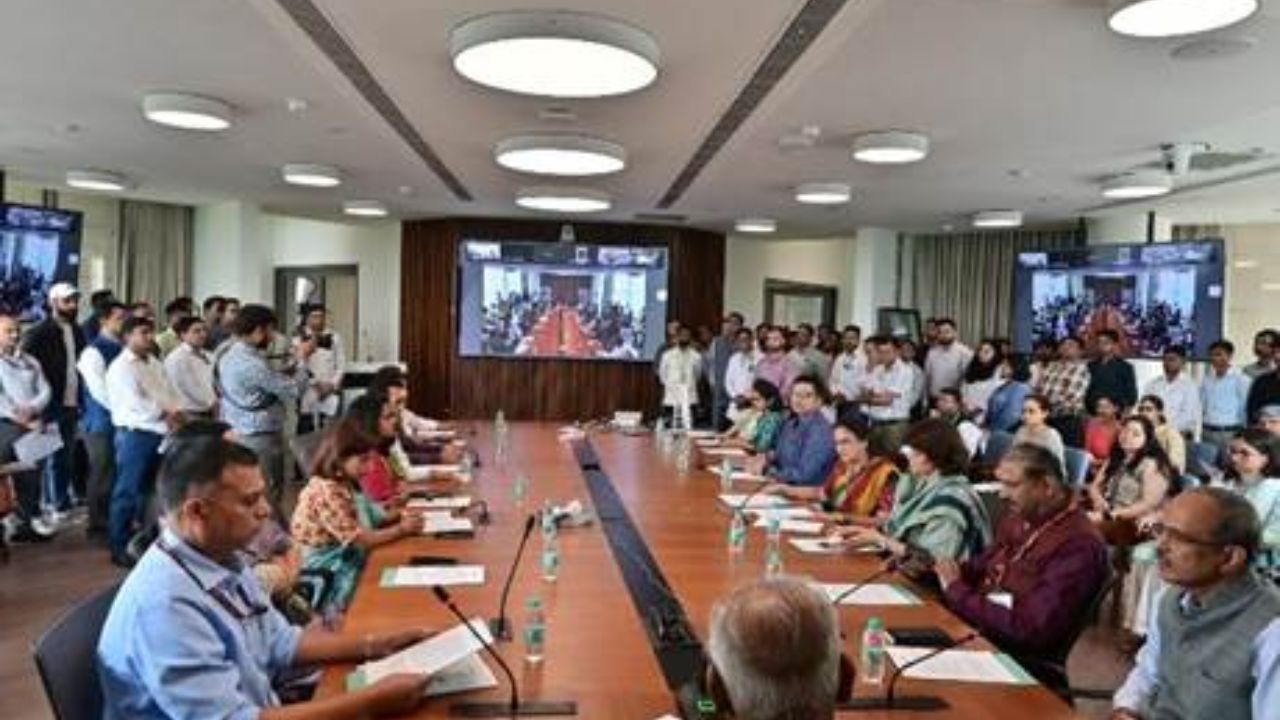
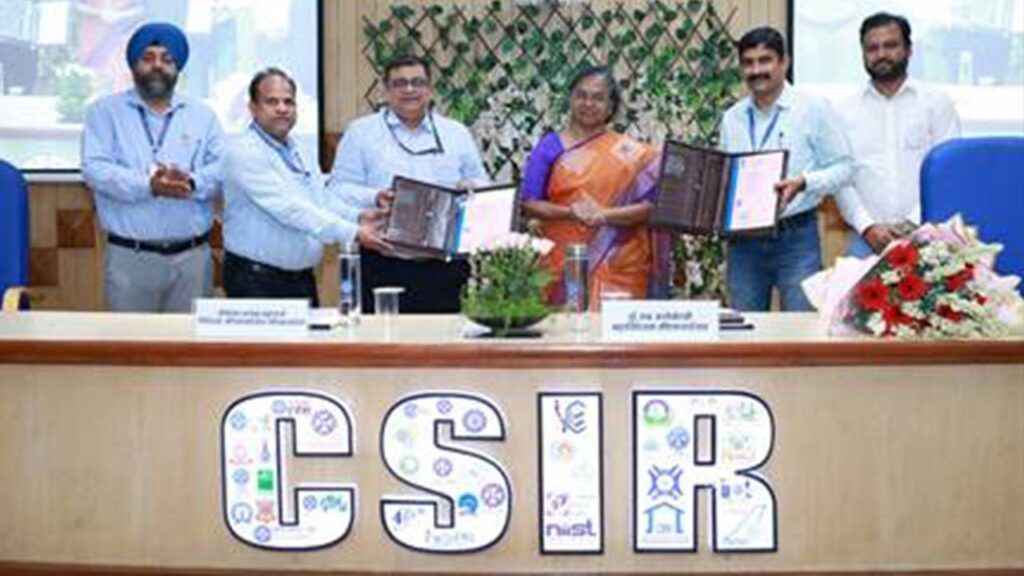

The Council of Scientific and Industrial Research (CSIR) has taken another step towards strengthening the commercial adoption of indigenous scientific innovations by facilitating the transfer of technologies developed by its specialised laboratories to industry. A Technology Transfer Event was organised at CSIR Headquarters in New Delhi, bringing together innovations from CSIR-Central Leather Research Institute (CSIR-CLRI), Chennai, and CSIR-Central Road Research Institute (CSIR-CRRI), New Delhi.
Held at the SSB Auditorium, the event featured presentations on the technologies developed by the two laboratories, followed by their transfer to industry. Dr. N. Kalaiselvi, Secretary, Department of Scientific and Industrial Research (DSIR) and Director General, CSIR, addressed the gathering. The Directors of CSIR-CLRI and CSIR-CRRI also shared their views on the technologies and their potential for industrial application.
The innovations presented at the event focus on several important areas, including industrial waste management, resource recovery, circular economy, road safety and sustainable infrastructure. The technology transfers reflect CSIR’s efforts to move research outcomes beyond laboratories and support their adoption in real-world applications.
CSIR-CLRI develops solutions for industrial waste
Among the technologies showcased by CSIR-CLRI was a process for converting chrome shavings generated by the leather industry into protein-based syntans. Chrome shavings are a difficult-to-degrade solid waste containing collagen protein that can otherwise remain underutilised.
The CSIR-CLRI technology recovers chromium-free protein hydrolysate from chrome-shaving waste and processes it into acrylic-, phenolic- and melamine-based syntans. These materials can subsequently be used during leather retanning, creating a pathway for recovering value from an industrial waste stream.
The process has been demonstrated at a pilot scale of 100–200 kg and subsequently validated at a commercial scale of 1,500 kg. According to CSIR-CLRI, implementation of the technology could reduce total dissolved solids (TDS) in the post-tanning stream by up to 50 per cent. The patented technology has also undergone industry validation and is ready for commercial licensing.
CSIR-CLRI also presented a technology for recovering useful materials from spent pickling acid generated during steel processing. The highly acidic waste stream can pose environmental challenges, while the new process enables the recovery of iron and chloride and their conversion into value-added products such as pigment-grade iron oxide and ammonium chloride.
The approach supports the principles of a circular economy by converting hazardous waste into commercially useful materials, while simultaneously reducing pollution and promoting domestic manufacturing capabilities.
CSIR-CRRI innovations target road safety and maintenance
CSIR-CRRI presented two technologies aimed at addressing practical challenges in road transportation and maintenance. One of these is ClariVisor, a glare-mitigation device designed for four-wheelers. The system is intended to be installed within the same footprint as the vehicle’s original equipment manufacturer (OEM) sun visor, avoiding the need for structural modifications to the vehicle.
The second technology, Two Pack Onsite Pothole Filling Mix, provides a cold-application solution for repairing potholes. The material comes in two separate packs that are blended at the site before application. Unlike conventional hot-mix repair methods, the process does not require a hot-mix plant or heating equipment.
The technology can therefore help reduce energy requirements and associated emissions while enabling quicker repair operations and earlier reopening of repaired road sections to traffic. Its solvent-free formulation further supports its application as an alternative approach to conventional pothole repair.
Addressing the gathering, Dr. N. Kalaiselvi highlighted the importance of speeding up the transition of CSIR research from laboratories to industry. She stressed the need for scientific innovations to generate tangible environmental, economic and societal benefits.
The event reinforced CSIR’s focus on building stronger links between its laboratories and industry. By facilitating the commercial transfer of validated technologies, CSIR aims to expand the use of home-grown innovations and contribute to sustainable industrial practices, resource efficiency, safer roads and resilient infrastructure.
Also Read: Dr Jitendra Singh Inaugurates SPROUT Facility to Accelerate Climate-Resilient Crop Research