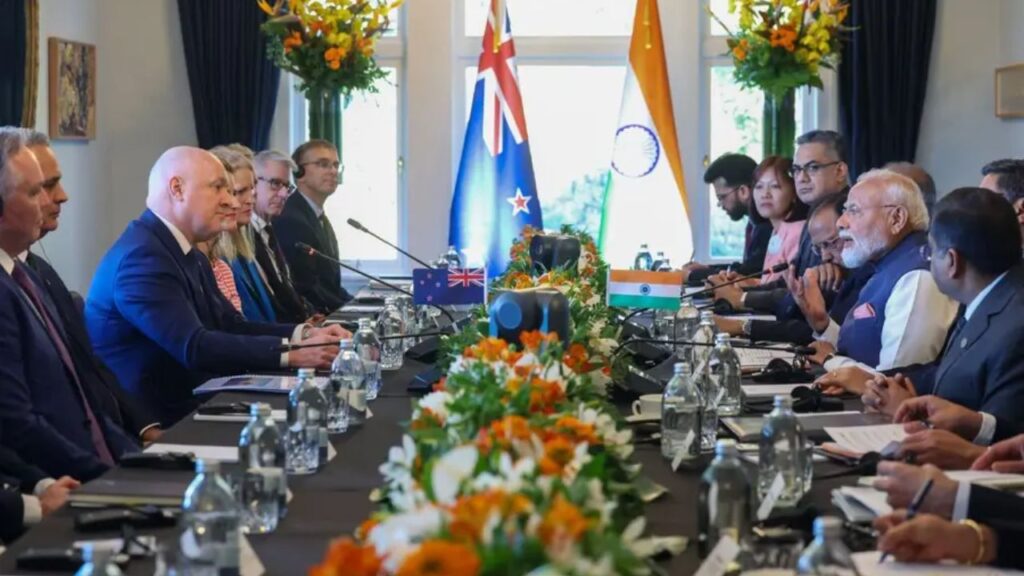

India and New Zealand have significantly strengthened their bilateral relationship by elevating it to a Strategic Partnership, marking a new chapter in diplomatic, economic and security cooperation. The announcement came during Prime Minister Narendra Modi’s official visit to Auckland on July 10–11, 2026, the first visit by an Indian Prime Minister to New Zealand in four decades.
The landmark visit underscored the growing convergence between the two democracies and resulted in the adoption of the India–New Zealand Strategic Partnership: Roadmap to 2030, a comprehensive framework aimed at deepening collaboration across a wide range of sectors over the next four years.
Historic Visit Reinforces Bilateral Momentum
Prime Minister Modi was accorded a ceremonial welcome at Government House and held extensive bilateral discussions with New Zealand Prime Minister Christopher Luxon. During the visit, he also interacted with business leaders, members of the Indian diaspora and witnessed demonstrations of New Zealand’s sporting innovation.
The two leaders recalled the progress made since Prime Minister Luxon’s visit to India in March 2025, when negotiations for a Free Trade Agreement (FTA) were launched and several agreements covering defence, education, customs, horticulture, forestry and sports were signed.
Recognising the shared democratic values, strong people-to-people ties and common interests in the Indo-Pacific, both countries agreed to institutionalise their cooperation under the newly announced Strategic Partnership.
Enhanced Political and Defence Cooperation
As part of the new framework, India and New Zealand agreed to intensify high-level political engagement through regular reciprocal visits by ministers and annual dialogues between their foreign ministries.
The two countries also decided to establish a regular Foreign Ministers’ Dialogue to review progress under the Roadmap to 2030 and provide strategic direction to the expanding partnership.
Defence and maritime cooperation emerged as another major pillar of the agreement. Both sides welcomed progress under the 2025 Memorandum of Understanding on Defence Cooperation and pledged to strengthen coordination between their defence establishments.
The leaders also committed to expanding maritime cooperation through newly concluded agreements on maritime security, hydrography, nautical cartography and logistics support. They agreed to launch an annual Maritime Security Dialogue while enhancing cooperation on cyber security, counter-terrorism, organised crime and law enforcement.
Trade Target Set at NZ$7 Billion by 2030
Economic cooperation received significant attention during the talks, with both Prime Ministers setting an ambitious target of doubling bilateral trade in goods and services to NZ$7 billion (approximately ₹35,000 crore) by 2030.
The leaders welcomed the conclusion and signing of a balanced and mutually beneficial India–New Zealand Free Trade Agreement and committed to ensuring its early implementation.
The agreement is expected to improve market access, encourage investments and strengthen cooperation in sectors including manufacturing, agriculture, clean energy, innovation and skills development.
Tourism also featured prominently in the discussions. Both sides welcomed a new tourism cooperation arrangement and reiterated support for establishing direct non-stop flights between India and New Zealand to boost connectivity.
Agriculture, Education and Innovation in Focus
Agriculture remains an important area of collaboration, with both countries agreeing to strengthen partnerships in horticulture, forestry, dairy farming and animal husbandry.
The leaders welcomed the Agricultural Productivity Partnership under the FTA, which will support collaborative projects aimed at improving productivity in crops such as kiwifruit, apples and honey. New Zealand also expressed support for establishing Centres of Excellence for kiwifruit cultivation in India.
Education, research and technology were identified as key drivers of future cooperation. The two nations pledged to expand academic exchanges, institutional partnerships, scientific research and innovation initiatives while promoting student mobility.
Climate action also featured prominently, with both countries agreeing to deepen cooperation through the International Solar Alliance, the Coalition for Disaster Resilient Infrastructure and the Global Biofuels Alliance, which New Zealand recently joined.
Additionally, a Memorandum of Cooperation on disaster management was signed to strengthen collaboration in disaster preparedness, response and resilience building.
Shared Vision for the Indo-Pacific
The two Prime Ministers reaffirmed their commitment to maintaining a free, open, peaceful and rules-based Indo-Pacific. They emphasised respect for international law, freedom of navigation and peaceful resolution of disputes.
On global issues, both countries reiterated support for reform of the United Nations Security Council, with New Zealand once again backing India’s bid for permanent membership of an expanded Council.
The leaders also strongly condemned terrorism in all its forms, called for dismantling terrorist infrastructure and agreed to establish a Joint Working Group on Counter-Terrorism to enhance intelligence sharing and cooperation.
Concluding the visit, both Prime Ministers directed officials to ensure timely implementation of the Roadmap to 2030, expressing confidence that the Strategic Partnership would unlock new opportunities for cooperation and further strengthen the longstanding friendship between India and New Zealand.