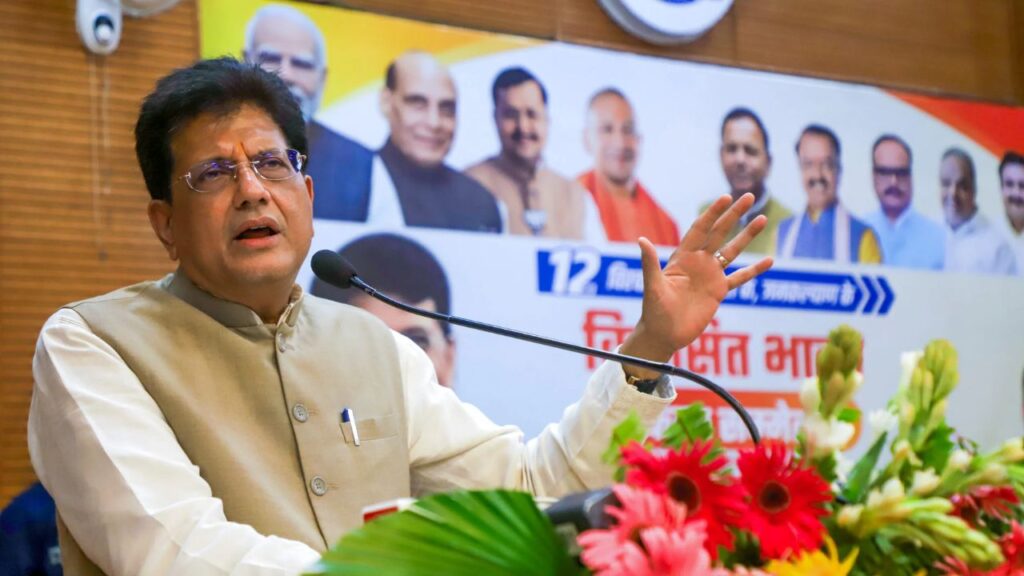

Union Minister of Commerce and Industry Piyush Goyal has emphasized that India’s strategy of signing Free Trade Agreements (FTAs) with developed economies is aimed at accelerating long-term economic growth through greater global engagement, investment inflows, innovation, employment generation and deeper integration into international trade networks.
Speaking at the closing session of the 5th Annual Meeting of India Global Innovation Connect in New Delhi, the minister highlighted the transformative role of trade partnerships in shaping India’s economic future. He noted that India’s engagement with advanced economies is based on complementarity rather than competition, creating opportunities that benefit both sides.
Referring to the Trade and Economic Partnership Agreement (TEPA) between India and the European Free Trade Association (EFTA) nations—Switzerland, Norway, Liechtenstein and Iceland—Goyal described the agreement as a milestone in strengthening trade, investment and innovation-led collaboration. He said the pact provides a strong framework for companies from both regions to establish long-term partnerships and unlock new business opportunities.
The minister revealed that EFTA countries have committed to investing USD 100 billion in India over a 15-year period, a move expected to generate around one million direct jobs. According to him, the investment commitment forms a key pillar of the agreement and ensures balanced benefits for all participating countries. India is currently in the second year of implementing the pact, and discussions on investment opportunities under the framework are progressing actively.
Highlighting India’s demographic advantage, Goyal pointed out that while many developed economies are facing ageing populations and workforce shortages, India continues to enjoy the benefits of a young and dynamic population. With an average age below 30 years and a strong talent pool, India is well-positioned to meet the demands of future industries and global markets.
The minister noted that rising production and research costs in developed nations have created opportunities for collaboration. By combining India’s skilled workforce, competitive cost structure and expanding domestic market with the capital and technological expertise of developed economies, mutually beneficial partnerships can be established.
Goyal informed that India has signed nine FTAs over the last three to three-and-a-half years, covering 38 countries. These agreements, he said, are opening new markets for Indian businesses, facilitating technology partnerships and strengthening the country’s participation in global value chains.
The minister also highlighted the government’s efforts to improve the ease of doing business. Reforms aimed at simplifying taxation, reducing compliance burdens, implementing insolvency and bankruptcy measures, and creating a predictable regulatory environment have helped make India a more attractive destination for investors.
On infrastructure development, Goyal said India is investing heavily in future-ready infrastructure to support long-term growth. He pointed to the creation of a unified national power grid exceeding 500 gigawatts as a major achievement. The integrated grid has enhanced efficiency, improved stability and enabled greater adoption of renewable energy sources.
According to the minister, more than half of India’s installed electricity capacity now comes from renewable energy, reflecting the country’s commitment to sustainability. He also noted that India achieved its climate commitments under the Paris Agreement ahead of schedule and remains among the leading performers within the G20 on climate action.
The growing availability of renewable energy, combined with a stable policy environment and strong legal framework, is making India an attractive destination for data centres and technology investments. Goyal cited India’s low data costs, affordable infrastructure, robust intellectual property protections and vast consumer market as key advantages.
Addressing innovation, the minister acknowledged the need to further strengthen India’s research and development ecosystem. He announced that the government’s ₹1 lakh crore research and development innovation fund has begun operations, with the first set of projects already approved. He expressed confidence that India’s startup ecosystem, supported by public and private investments, would play a crucial role in driving future innovation.
Reiterating India’s commitment to open and rules-based trade, Goyal said the country welcomes both domestic and foreign companies that contribute to economic growth and job creation. He expressed confidence that trade partnerships, innovation-driven growth and infrastructure development would help position India as a leading force in the global economy in the coming decades.
Also Read: India Showcases Carbon Market and Green Energy Standards at WTO Environment Week in Geneva