
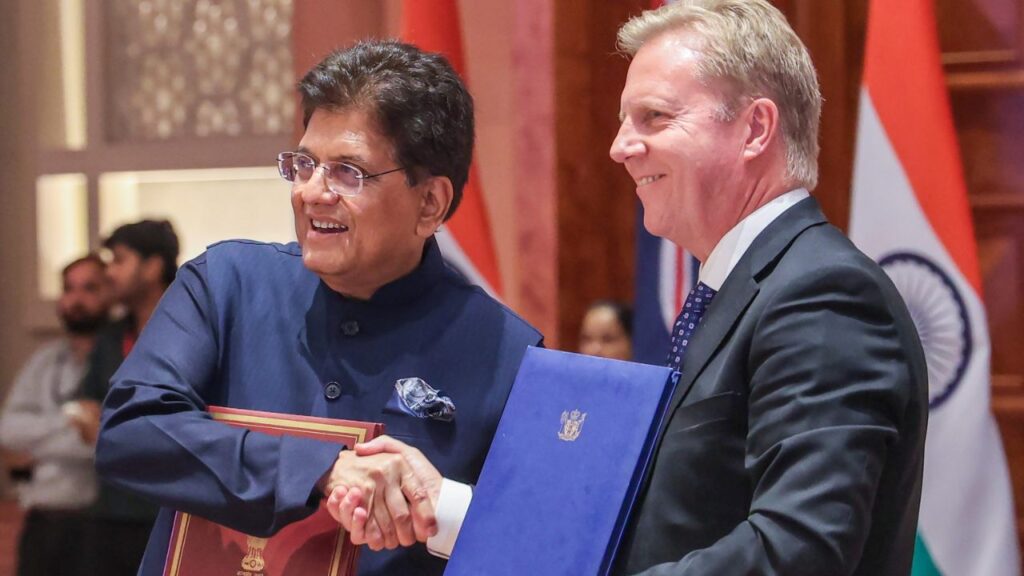

The India–New Zealand Free Trade Agreement (FTA) will enter into force on October 20, 2026, marking a significant milestone in the economic relationship between the two countries. The announcement was made during a virtual meeting between Union Minister of Commerce and Industry Piyush Goyal and New Zealand Minister for Trade and Investment Todd McClay following the completion of the required domestic procedures.
The agreement was signed on April 27, 2026, at Bharat Mandapam in New Delhi by Goyal and McClay. New Zealand’s Parliament subsequently passed the legislation implementing the agreement on September 16, 2026, paving the way for its formal operationalisation.
The FTA is expected to strengthen the broader India–New Zealand Strategic Partnership and support the objectives outlined in the India-New Zealand Strategic Partnership: Roadmap to 2030. During Prime Minister Narendra Modi’s visit to New Zealand in July 2026, the two countries announced the Strategic Partnership and set an aspirational target of doubling bilateral trade in goods and services to NZ$7 billion by 2030.
Goyal said the agreement would create greater economic synergies, support economies of scale and improve the competitiveness of businesses in both countries. He also noted that the FTA would take effect on Vijay Dashami (Dussehra), describing the date as symbolic of overcoming obstacles and opening a new phase in trade, technology and investment cooperation.
McClay said the agreement would provide greater certainty to businesses at a time of global trade uncertainty and rising tariffs. He described the pact as a foundation for wider cooperation involving business, investment, culture, sports and people-to-people ties.
A key feature of the agreement is New Zealand’s commitment to provide duty-free access for 100% of India’s exports from the date of entry into force. Indian sectors such as textiles and apparel, leather and footwear, gems and jewellery, engineering products and processed foods are expected to benefit from the removal of tariffs, including duties that currently reach up to 10%.
Indian manufacturers will also gain improved access to important industrial inputs, including wooden logs, coking coal and metal scrap, potentially helping reduce input costs and strengthen export competitiveness.
At the same time, India has retained tariff protection for several sensitive agricultural and food products. Dairy, most animal meat, key agricultural commodities, sugar and edible oils have been excluded from tariff concessions. New Zealand’s apples, kiwifruit and Manuka honey will receive calibrated access through tariff-rate quotas, minimum import price provisions and seasonal import windows.
The agreement also introduces an Agriculture Productivity Partnership, under which the two countries will cooperate on improving agricultural productivity, quality, supply chains and farmer incomes. Action plans covering kiwifruit, apples and honey will facilitate technology and knowledge exchange, while Centres of Excellence will focus on areas such as orchard management, post-harvest practices, food safety and sustainable beekeeping.
Investment cooperation is another major component of the FTA. New Zealand has committed to facilitate USD 20 billion in investment into India, with potential opportunities across agriculture, manufacturing, infrastructure and start-ups.
India’s services sector is also expected to gain from expanded market access across approximately 118 sectors, including information technology, professional services, construction, tourism and audio-visual services. The agreement provides for 5,000 Temporary Employment Entry visas for skilled Indian workers and 1,000 Working Holiday visas annually for young Indians.
The pact further provides enhanced student mobility, including post-study work opportunities of up to three years for STEM graduates and four years for doctoral scholars.
Pharmaceutical and medical-device exporters are expected to benefit from New Zealand’s acceptance of inspection approvals from regulators such as the US FDA, European Medicines Agency, UK MHRA and Health Canada.
With bilateral merchandise trade reaching around USD 1.1 billion in 2025–26, the implementation of the FTA is expected to deepen commercial ties and create new opportunities for businesses, workers, farmers, entrepreneurs and MSMEs in both countries.

Author: Shivam
Proficient Writer Contact: [email protected]