
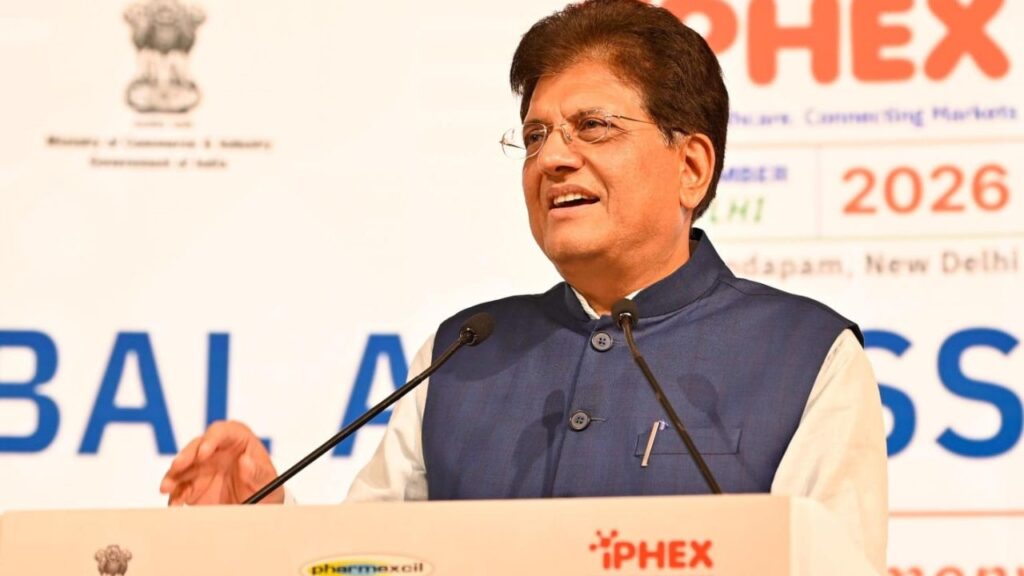

Union Minister of Commerce and Industry Shri Piyush Goyal has called for India to build on its reputation as the “pharmacy of the world” and establish itself as a leading global destination for medical and healthcare services.
Addressing the Pharma Machtech and Labnext Expo 2026 in New Delhi, Goyal said India’s healthcare ambitions must extend beyond medicines and treatment. He underlined the need to develop a comprehensive ecosystem covering preventive healthcare, wellness, diagnostics, caregiving, medical devices, laboratory infrastructure, telemedicine, digital health, innovation and research.
Healthcare Sector Offers Vast Growth Potential
The Minister said medical and pharmaceutical machinery, consumables and allied industries have considerable potential to boost merchandise exports, reduce import dependence and expand services exports. According to him, the healthcare ecosystem can generate crores of employment opportunities, support thousands of businesses and encourage the creation of lakhs of startups, particularly in the rapidly developing medtech segment.
Goyal encouraged entrepreneurs and industry leaders to view healthcare as a major avenue for creating jobs and income for young Indians while simultaneously improving access to quality healthcare across the country.
He also called for stronger incubation and startup-support systems for medtech, medical equipment and consumables. Greater attention, he said, should be given to product design, copyrights, patents and intellectual property to help Indian innovations compete internationally.
FTAs Can Open New Global Markets
Highlighting the opportunities created by India’s expanding network of free trade agreements (FTAs), Goyal urged pharmaceutical and healthcare companies to take greater advantage of preferential market access.
He noted that India’s FTAs before 2014 collectively covered economies with a GDP of about $10 trillion. In contrast, nine free trade and bilateral trade agreements concluded during the past four to four-and-a-half years cover economies with a combined GDP of approximately $60 trillion. Ongoing negotiations could potentially increase this coverage to around $75 trillion.
These agreements, he said, can provide Indian businesses with access to international markets at lower preferential duties while also creating opportunities in services and professional mobility.
Focus on Technology and Strategic Partnerships
Goyal stressed that India does not need to develop every technology from scratch. Instead, the country should identify suitable technologies globally, bring them to India and simultaneously take successful Indian technologies to overseas markets.
He advocated greater collaboration through technology partnerships, joint ventures, licensing, co-designing, co-development and knowledge transfer. The Minister also encouraged international R&D institutions and major pharmaceutical companies to establish design and innovation centres in India.
He emphasised that self-reliance in medicines, research and medical equipment is essential for strengthening India’s healthcare security. Export Promotion Councils and industry bodies, he said, should actively contribute to this effort.
Lessons from COVID-19
The Minister highlighted the importance of building resilient healthcare supply chains and increasing domestic manufacturing capabilities. Recalling the shortages of oxygenators and ventilators during the COVID-19 pandemic, he said India must learn from those experiences and strengthen its ability to manufacture critical medical equipment domestically.
At the same time, he stressed that indigenisation must never come at the expense of quality. Indian manufacturers must maintain internationally competitive standards and ensure “zero compromise” on quality.
Goyal also pointed to the government’s commitment of ₹1 lakh crore towards research, innovation and funding, urging the industry and research community to use these resources to develop advanced medical equipment, innovative medicines and newer drugs.
Building a World-Class Healthcare Ecosystem
The Minister envisioned an integrated healthcare ecosystem in which Indian pharmaceuticals and medical equipment are combined with the expertise of doctors, nurses, caregivers, technicians, hospital administrators, engineers and other professionals.
He said India should aspire not only to deliver affordable, high-quality healthcare to its own citizens but also to provide wellness and healthcare services to people around the world.
Artificial Intelligence, he added, can improve efficiency and help healthcare professionals work more effectively, while human involvement in nursing and caregiving will remain indispensable.
Shared Testing Infrastructure Needed
Goyal also proposed strengthening the critical component ecosystem by establishing shared testing facilities. Such centres could enable Indian manufacturers to test and benchmark their equipment against global standards, obtain certifications and demonstrate product quality to international buyers.
He said the government would support the procurement of advanced technical testing equipment for such facilities in government-supported or university laboratories.
The Minister further highlighted India’s cost advantage in R&D and called for stronger cooperation among industry, academia, medical colleges, IITs and other centres of excellence. He said India has significant potential to become a global hub for innovation, product design, clinical trials and medical equipment manufacturing.
With 100 per cent FDI permitted through the automatic route in the pharmaceutical sector, Goyal said India is well placed to attract international investment and technology. Referring to the Economic Survey 2025–26, he noted the pharmaceutical industry’s transition from a volume-driven model towards greater value creation.
He expressed confidence that coordinated efforts by industry, startups, entrepreneurs, researchers and healthcare professionals can help transform India into a global healthcare powerhouse and support the country’s broader objective of becoming a developed nation by 2047.

Author: Shivam
Proficient Writer Contact: [email protected]