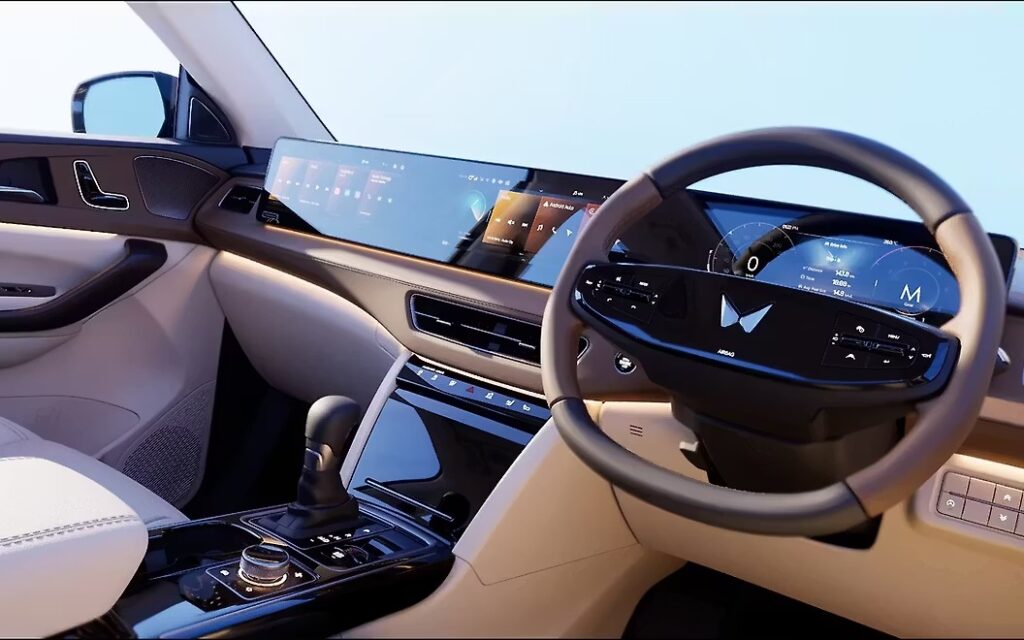

When a car that was just launched shows up on test roads again, covered head to toe in camouflage wrap, the obvious question is: what exactly is Mahindra trying to hide? Design changes would be pointless this soon after launch. Which leaves one very interesting possibility — Mahindra is working on something under the hood, and the XUV 7XO might be the first vehicle to show it.
The recently spotted test mule of the XUV 7XO looked identical to the production car on the outside. No new body panels, no reshaped bumpers, no updated lighting. That tells you something important: whatever Mahindra is developing here is about the powertrain, not the styling. And given where the Indian auto market is heading, that makes complete sense.
Why flex fuel is suddenly a big conversation in India
The Indian government recently released a draft policy around E85 petrol — a fuel blend that contains 85 percent ethanol and 15 percent petrol. This is not a fringe idea anymore. The push toward flex fuel vehicles is very real, and manufacturers have been paying close attention. Since that draft came out, the chatter around flex fuel compatibility in upcoming models has picked up considerably across the industry.
Mahindra already showed a flex fuel version of the XUV 3XO back in 2025, so the company clearly has the engineering groundwork in place. Applying that same technology to the larger XUV 7XO is not a big leap — especially since both vehicles share the same 2.0-litre turbocharged petrol engine as their base.
The hybrid possibility — and why it is the more likely bet
Earlier reports had suggested that the XUV 7XO could be the first Mahindra model to receive a strong hybrid setup. The Scorpio N has also been mentioned in connection with this technology. If those reports hold up, what Mahindra is testing is a mild-to-strong hybrid system built around the existing 2.0-litre turbo petrol unit — the same engine that currently produces 203 PS and 380 Nm in standard trim.
In a hybrid configuration, that output would go up. Electric assist typically adds meaningful torque at lower revs, which would make the XUV 7XO even more responsive in city traffic — exactly where hybrid systems deliver the most noticeable benefit. Fuel efficiency numbers would also improve, which matters quite a bit for a car in this size and price bracket.
The current transmission options — a 6-speed manual and a 6-speed automatic — may or may not carry over unchanged depending on the hybrid architecture Mahindra ultimately chooses. Strong hybrid systems often pair with dedicated transmissions to maximise efficiency gains.
Mahindra’s bigger picture: shifting away from diesel
Here is the broader context that makes all of this important. Mahindra’s sales volumes still rely heavily on diesel-powered models. That is not a sustainable position as the market moves. Data from the Indian auto sector shows that the combined share of CNG, electric, and hybrid vehicles has crossed 30 percent of total sales — a number that would have seemed impossible just three or four years ago.
Mahindra knows this. The company has already made significant commitments on the electric vehicle front with its BE and XEV series. But EVs are not for everyone yet — range anxiety, charging infrastructure, and upfront costs remain barriers for a large chunk of the buying public. Hybrids and flex fuel vehicles serve that middle ground very effectively, appealing to buyers who want to move away from full fossil fuel dependency without making the full jump to electric.
Range extender hybrids for EVs — another track Mahindra is exploring
Separate from the XUV 7XO testing, Mahindra is also reportedly working on a range extender hybrid architecture specifically designed for its electric vehicles. This would involve a small combustion engine that acts as a generator to charge the battery while driving — addressing range anxiety without requiring frequent stops at charging stations. It is a technology that has gained traction globally and is now being explored seriously in India.
What to watch for next
Mahindra has not confirmed anything officially about the XUV 7XO test mule or the specific powertrain being evaluated. But the combination of factors — government flex fuel policy, the company’s own hybrid roadmap, and the XUV 3XO precedent — points fairly clearly in one direction. Whether it is an E85-capable engine, a strong hybrid system, or both eventually, the XUV 7XO appears to be Mahindra’s chosen platform for the next phase of its powertrain strategy. More clarity should emerge in the months ahead.