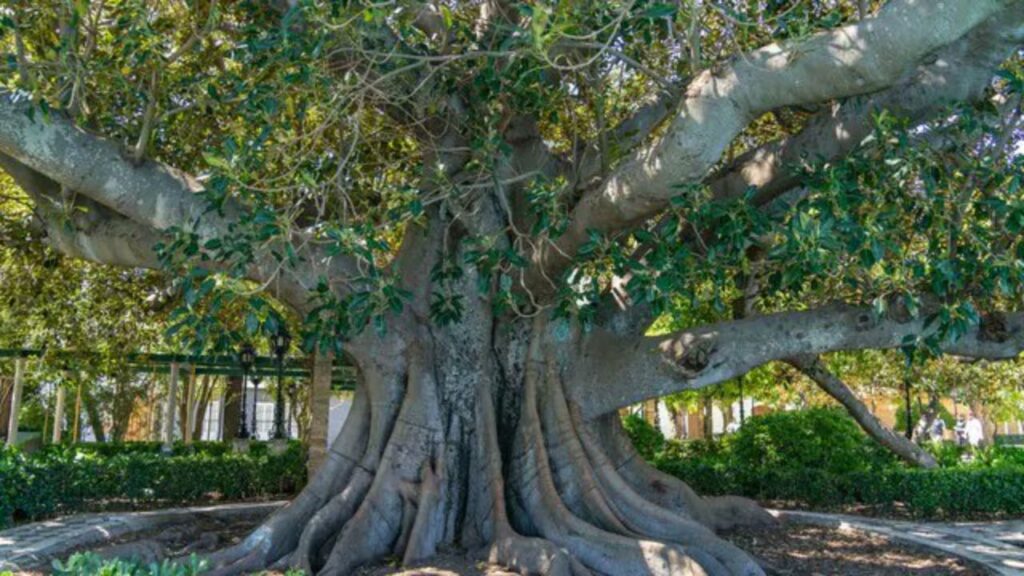

In a landmark scientific discovery, researchers have accurately determined that a banyan tree in Bihar’s Munger district is around 700 years old, making it the oldest scientifically dated Ficus benghalensis (banyan tree) known to date. The finding, achieved through high-precision radiocarbon dating, marks a significant advance in the scientific study and conservation of ancient tropical trees.
The research replaces traditional age estimates based on folklore, local legends, and historical records with a robust scientific approach. The breakthrough provides a reliable method for determining the age of heritage trees, paving the way for stronger conservation efforts across India and other tropical regions.
Scientific Method Solves Long-Standing Challenge
Banyan trees occupy a unique place in India’s ecological, social, and cultural landscape. Their vast network of trunks, branches, and aerial roots supports diverse wildlife, including birds, insects, and other organisms. They have also served for centuries as gathering spaces for village councils, religious events, and community interactions.
Despite their importance, accurately determining the age of banyan trees has remained a challenge. Unlike many temperate trees, tropical broadleaf species generally lack distinct annual growth rings, making conventional dendrochronology ineffective.
Recognising this limitation, Dr. Trina Bose of the Birbal Sahni Institute of Palaeosciences (BSIP), Lucknow, an autonomous institute under the Department of Science and Technology (DST), developed an alternative scientific protocol after being invited by the Bihar Forest Department to study the Munger banyan.
Dr. Bose led the research along with Dr. Mayank Shekhar and Dr. Akhilesh K. Yadava, who together designed and implemented an innovative methodology to establish the tree’s age with high confidence.
Radiocarbon Dating Reveals Tree’s True Age
The research team collected carefully selected wood samples from near the pith of a secondary trunk and an ancient primary branch. The pith is particularly valuable because it contains the earliest wood formed during the tree’s juvenile growth stage.
Researchers extracted alpha-cellulose—the most stable structural component of plant cell walls—from these samples. The purified cellulose was then analysed using Accelerator Mass Spectrometry (AMS) for high-precision radiocarbon dating.
The radiocarbon data were calibrated using the latest IntCal20 calibration curve and analysed through OxCal software, enabling the scientists to establish a reliable age estimate of approximately 700 years.
The study demonstrates that radiocarbon dating can effectively overcome the limitations posed by tropical trees that lack visible annual growth rings.
Discovery Rewrites Local History
The scientific findings challenge a long-held assumption regarding the origin of the Munger banyan tree.
Previously, it was widely believed that the tree had been planted in front of the historic Burra Bunglow, a structure dating back approximately 300 to 350 years to the late Mughal-Early British period. The site was traditionally associated with public meetings, cultural exchanges, religious gatherings, and interactions between rulers and local communities.
However, the new evidence establishes that the banyan predates the building by several centuries.
Researchers now conclude that the tree is likely a surviving remnant of a natural forest that once covered the region and was already standing when the Burra Bunglow was constructed. This finding effectively reverses the previously accepted sequence of historical events in the area, highlighting the tree as a silent witness to centuries of regional history.
Implications for Heritage Conservation
The research, published in the journal Quaternary Research, has important implications beyond the Munger banyan.
The newly developed methodology offers governments, forest departments, archaeologists, and conservation agencies a dependable scientific tool for identifying and protecting ancient trees of ecological, historical, and cultural significance.
Replacing uncertain estimates with scientifically verified ages can strengthen heritage conservation policies, improve biodiversity management, and support environmental education. The technique can also contribute to studies of historical landscapes and past climate by providing more accurate timelines for long-lived tropical trees.
Researchers believe the methodology can be applied to ancient tropical tree species worldwide, opening new opportunities for scientific investigation and conservation.
The successful dating of the Munger banyan represents a major milestone in tropical tree research. Beyond confirming the remarkable age of one of India’s iconic trees, the study establishes a new benchmark for scientifically documenting living natural heritage and preserving it for future generations.