
The Department of Commerce has stepped up efforts to help India’s seafood industry tap into new export opportunities under the India-European Free Trade Association (EFTA) Trade and Economic Partnership Agreement (TEPA). A high-level Chintan Shivir held in Chennai brought together government officials, export promotion agencies and industry leaders to discuss how the agreement can strengthen India’s position in premium European seafood markets.
The brainstorming session, organised on July 3, 2026, at the Chennai Trade Centre, was conducted alongside Seafood Expo Bharat 2026 and focused on enabling exporters to fully utilise the benefits offered under TEPA.
TEPA Marks a New Phase in India’s Trade Strategy
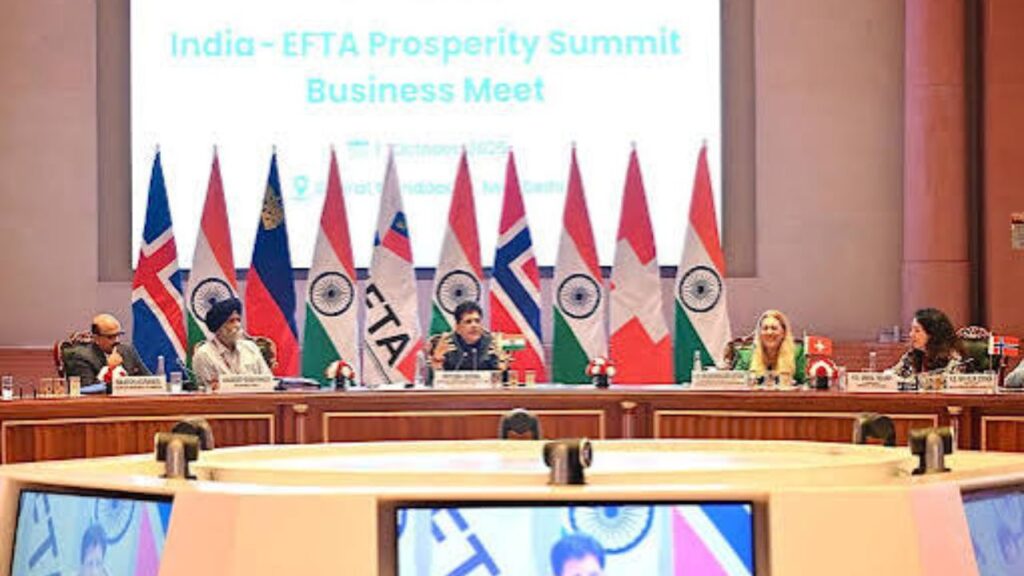
The India-EFTA TEPA represents a significant milestone in India’s international trade policy. It is the country’s first trade agreement with the four-member European Free Trade Association, comprising Iceland, Liechtenstein, Norway and Switzerland. The pact also marks India’s first operational trade arrangement with a European economic bloc, complementing ongoing trade engagements with the European Union and the United Kingdom.
The combined economy of the EFTA member nations is valued at around USD 1.79 trillion, making the bloc an attractive destination for Indian exports. Beyond trade, the agreement aims to attract nearly USD 100 billion in investments into India and create around one million direct jobs over time. It is also expected to encourage technology transfer, joint ventures and collaboration with advanced technology firms based in EFTA countries.
Tariff Benefits to Boost Seafood Exports
One of the major attractions of the agreement for the seafood industry is the significant reduction in import duties across EFTA markets.
Under TEPA, Iceland has removed its 55 per cent import tariff on feed, including fish feed, reducing production costs for businesses linked to aquaculture. Norway has also eliminated its 13.16 per cent import duty on fish and shrimp feed, while Switzerland has reduced the import duty on fish fats and oils, excluding liver oil, from 18.05 per cent to zero.
These tariff concessions are expected to improve the competitiveness of Indian seafood products and related value-added exports, particularly benefiting exporters from coastal states such as Tamil Nadu, Andhra Pradesh, Kerala and Gujarat.
Government and Industry Discuss Growth Opportunities
The event witnessed participation from Joint Secretary in the Department of Commerce, Shri Mohit Yadav, along with representatives from Invest India, the Directorate General of Foreign Trade (DGFT), the Export Inspection Council (EIC), and the Federation of Indian Export Organisations (FIEO). Leading seafood exporters and businesses exploring opportunities in EFTA markets also joined the discussions.
Addressing the gathering, Mohit Yadav highlighted the investment and export opportunities available under the trade agreement and encouraged businesses to strategically position themselves to benefit from the expanded market access.
Officials from Invest India presented investment prospects across the seafood value chain, covering processing, logistics, cold-chain infrastructure and value-added products. Representatives from DGFT explained various export promotion schemes and government initiatives designed to improve ease of doing business and support exporters in accessing international markets.
Meanwhile, experts from EIC and FIEO guided participants on quality certification, international standards and regulatory compliance required to successfully enter EFTA markets.
Interactive Session Addresses Industry Concerns
A major feature of the programme was an interactive open-house session where seafood exporters directly engaged with senior government officials. Industry representatives raised questions related to market access, export documentation, compliance with international food safety regulations and strategies for expanding India’s presence in high-value European markets.
The discussions also explored ways to strengthen India’s seafood value chain through better infrastructure, improved quality standards and closer collaboration between government agencies and private enterprises.
Focus on Long-Term Export Growth
The Chintan Shivir concluded with a shared commitment from both government and industry to maximise the benefits of the India-EFTA Trade and Economic Partnership Agreement.
Participants agreed that effective utilisation of tariff concessions, improved regulatory preparedness and stronger industry-government collaboration would play a crucial role in expanding India’s seafood exports. With growing global demand for high-quality seafood products and improved market access under TEPA, the agreement is expected to provide fresh momentum to India’s seafood sector while enhancing the country’s export competitiveness in Europe.

Author: Shivam
Shivam Dwivedi is a senior journalist with extensive experience in research-driven journalism, policy communication, and multi-platform storytelling. His areas of interest include international relations, defence, science & technology, education, urban development, agriculture, spirituality, and environmental sustainability. His work focuses on in-depth analysis, public discourse, and impactful narratives across governance and development sectors, with a strong commitment to the Sustainable Development Goals (SDGs). Contact: [email protected]