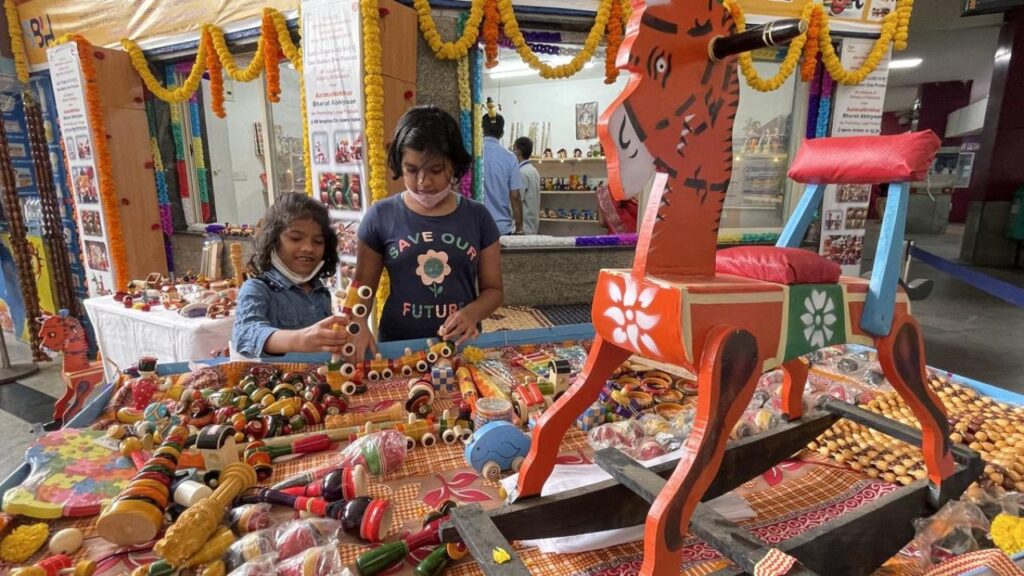

India’s toy industry has undergone a significant transformation over the past few years, emerging as a stronger and more competitive manufacturing sector driven by quality reforms, policy interventions, and export growth. While the country does not yet have a dedicated national toy policy, a series of coordinated government initiatives have helped improve product standards, reduce dependence on imports, and strengthen the domestic toy ecosystem.
The progress was highlighted alongside the successful conclusion of the 17th Toy Biz International B2B Exhibition, held at Bharat Mandapam in New Delhi from July 4 to 7, 2026. Organized by the Toy Association of India, the event brought together manufacturers, buyers, exporters, retailers, and industry stakeholders from across the globe.
Toy Biz Exhibition Showcases Industry Potential
The four-day exhibition featured participation from around 400 Indian toy brands, attracted nearly 100 international buyers representing 40 countries, and welcomed approximately 30,000 business visitors. The platform enabled direct interactions between manufacturers, wholesalers, distributors, institutional buyers, retailers, and e-commerce companies, creating new opportunities for business partnerships and export expansion.
The exhibition reflected the growing confidence in India’s toy manufacturing capabilities and its ambition to become a major player in the global toy market.
From Low-Quality Imports to Better Domestic Standards
A few years ago, India’s toy market was heavily dependent on imported products. During 2018-19, toy imports were valued at USD 371.7 million, with a significant share consisting of inexpensive, substandard, counterfeit, and unsafe products.
Concerns over product quality became more evident after a mystery shopping exercise conducted in 2019 found that only 33 percent of toys available in the domestic market complied with the quality standards prescribed by the Bureau of Indian Standards (BIS).
Recognizing these challenges, the Government of India launched multiple measures aimed at improving toy safety, encouraging indigenous manufacturing, and strengthening quality compliance.
Multi-Ministry Action Plan Drives Reforms
A major initiative has been the formulation of the National Action Plan for Toys (NAPT), comprising 21 action points coordinated by 14 ministries and departments.
The action plan seeks to promote toy designs inspired by Indian culture, heritage, and values while encouraging the use of educational toys in classrooms. It also focuses on organizing toy hackathons, design competitions, toy fairs, strengthening quality monitoring mechanisms, discouraging imports of unsafe toys, promoting indigenous manufacturing clusters, and boosting domestic production.
Higher Import Duties and Strict Quality Controls
To support domestic manufacturers, the government progressively increased the Basic Customs Duty (BCD) on toys under HS Code 9503 from 20 percent to 60 percent in February 2020, followed by another increase to 70 percent in 2023.
Additionally, the customs duty on parts of electronic toys (HS 95030091) was revised to 20 percent in the Union Budget for FY 2025-26.
Another landmark reform came through the Quality Control Order (QCO) issued on February 25, 2020, which became effective from January 1, 2021, making compliance with BIS safety standards mandatory.
The BIS has since granted more than 1,800 licenses to domestic toy manufacturers and over 50 licenses to foreign manufacturers for using the BIS Standard Mark on toys meeting Indian safety standards.
Building a Stronger Domestic Toy Ecosystem
The government has also focused on expanding manufacturing capacity through a cluster-based development strategy.
The Ministry of MSME has approved 18 toy clusters under the Scheme of Funds for Regeneration of Traditional Industries (SFURTI), while the Ministry of Textiles is providing design and tooling assistance to 40 toy clusters across the country.
Innovation has received additional support through initiatives such as Toycathon, toy fairs, and startup promotion. More than 700 startups engaged in the toy sector have been recognized under the Startup India initiative led by the Department for Promotion of Industry and Internal Trade (DPIIT).
Education and Trade Receive Equal Attention
The National Education Policy (NEP) 2020 has further strengthened the role of toys in learning by promoting play-based and activity-based education. To support this vision, NCERT has released a handbook on Toy-Based Pedagogy, encouraging the use of indigenous toys and games to improve children’s learning experiences.
On the export front, over 2,200 exporters have benefited from the Remission of Duties and Taxes on Exported Products (RoDTEP) scheme. Indian toy manufacturers have also gained improved market access through trade agreements with countries and regions including the UAE, Australia, EFTA members, Oman, New Zealand, and the United Kingdom.
Quality Gains Translate into Export Growth
The government’s interventions have produced measurable improvements in product quality. According to a BIS survey conducted in 2025, 95 percent of toy samples tested complied with prescribed quality standards, marking a dramatic improvement from the 33 percent compliance level recorded in 2019.
Trade figures also indicate a structural shift in the industry. Between FY 2018-19 and FY 2025-26, India’s toy imports declined by 37.5 percent, falling from USD 371.7 million to USD 232.3 million. During the same period, toy exports rose by 89.1 percent, increasing from USD 203.5 million to USD 384.7 million.
With exports now exceeding imports, India has emerged as a net exporter of toys, supplying products to major international markets including the United States, the United Kingdom, Germany, and the Netherlands.
The information was shared by Minister of State for Commerce and Industry, Shri Jitin Prasada, in a written reply in the Lok Sabha, underscoring the growing strength and global competitiveness of India’s toy manufacturing sector.

Author: Shivam
Shivam Dwivedi is a senior journalist with extensive experience in research-driven journalism, policy communication, and multi-platform storytelling. His areas of interest include international relations, defence, science & technology, education, urban development, agriculture, spirituality, and environmental sustainability. His work focuses on in-depth analysis, public discourse, and impactful narratives across governance and development sectors, with a strong commitment to the Sustainable Development Goals (SDGs). Contact: [email protected]