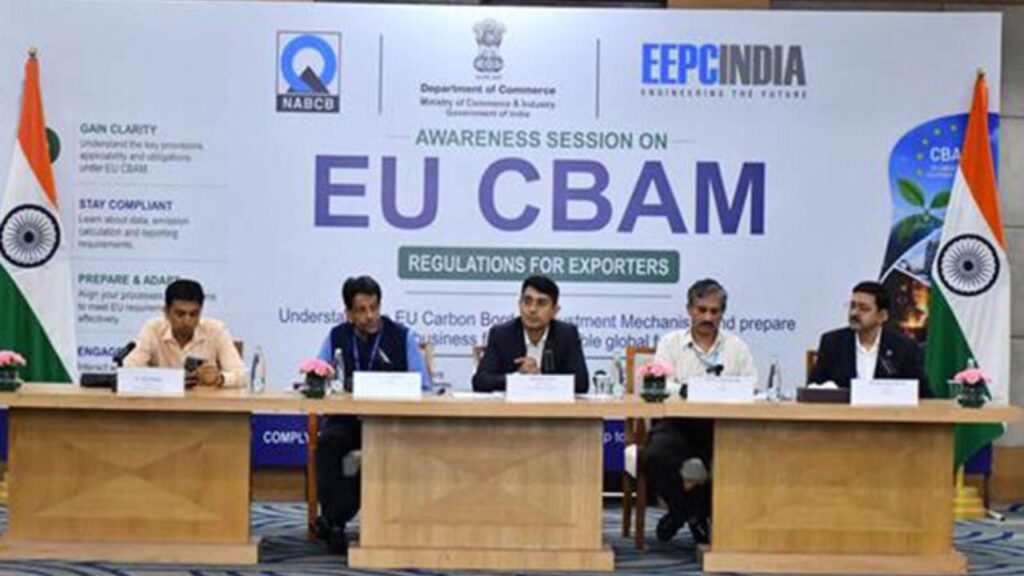

The Department of Commerce, Ministry of Commerce & Industry, in partnership with the National Accreditation Board for Certification Bodies (NABCB) and the Engineering Export Promotion Council (EEPC), organised an awareness session on the European Union’s Carbon Border Adjustment Mechanism (EU CBAM) for Indian exporters at Vanijya Bhawan, New Delhi.
The programme brought together around 100 exporters and industry representatives to strengthen their understanding of the EU’s evolving carbon-related trade requirements and help Indian businesses prepare for compliance. The initiative assumes significance as sustainability-linked regulations increasingly influence access to international markets.
The technical sessions offered participants an overview of the EU CBAM framework, including its scope, applicability and the categories of products covered under the mechanism. Experts also explained the obligations applicable to exporters, methods for calculating embedded carbon emissions, data collection procedures and reporting requirements.
A key focus of the programme was the role of accreditation and verification in establishing the credibility of emissions-related information. Participants were briefed on the relevant verification mechanisms and the importance of maintaining reliable data to meet regulatory requirements.
Practical examples from the iron and steel as well as aluminium sectors were also discussed. These case studies were intended to help exporters understand how CBAM-related provisions could be applied in real-world business situations and identify areas requiring greater preparedness within their supply chains.
Addressing the gathering, Joint Secretary in the Department of Commerce, Shri Amit Verma, stressed the need for Indian exporters to remain informed about emerging sustainability regulations in overseas markets. He said that exporters must develop adequate preparedness to respond effectively to changing regulatory expectations.
Verma also highlighted the Department of Commerce’s efforts to improve awareness among the exporting community and facilitate a clearer understanding of new international trade requirements. He reiterated that the Department is maintaining dialogue with industry and other stakeholders to address concerns and work towards practical solutions that can support Indian exporters.
CEO of NABCB, Shri N. Venkateswaran, underlined the significance of a reliable accreditation and verification ecosystem. According to him, credible systems for verifying emissions data are important for building confidence in information submitted under CBAM and supporting exporters in meeting the mechanism’s requirements.
EEPC Chairman Shri Pankaj Chadha highlighted that preparedness must extend across the entire export value chain. He pointed to the importance of obtaining accurate emissions-related information from suppliers and other stakeholders, while also stressing the need for effective verification systems to support exporters in demonstrating compliance.
The interactive session enabled exporters and industry representatives to raise questions and seek clarification on various regulatory and technical aspects of CBAM. Discussions covered issues related to compliance, emissions calculations, reporting and implementation, providing participants with greater clarity on the challenges involved.
The Department of Commerce reaffirmed its commitment to working closely with exporters, industry bodies and relevant institutions to build capacity and improve awareness of emerging sustainability-related trade regulations.
The initiative reflects the growing importance of environmental compliance in international commerce. As major markets introduce regulations linked to carbon emissions and sustainability, timely access to information, accurate emissions data and robust verification systems are becoming increasingly important for Indian exporters seeking to remain competitive globally.
The programme concluded with a question-and-answer session and further interaction between officials, experts and industry stakeholders, giving exporters an opportunity to address specific concerns and strengthen their preparedness for the evolving EU CBAM regulatory environment.
Also Read: Industrial Corridors Gain Momentum as Centre Pushes Faster Investment and Manufacturing