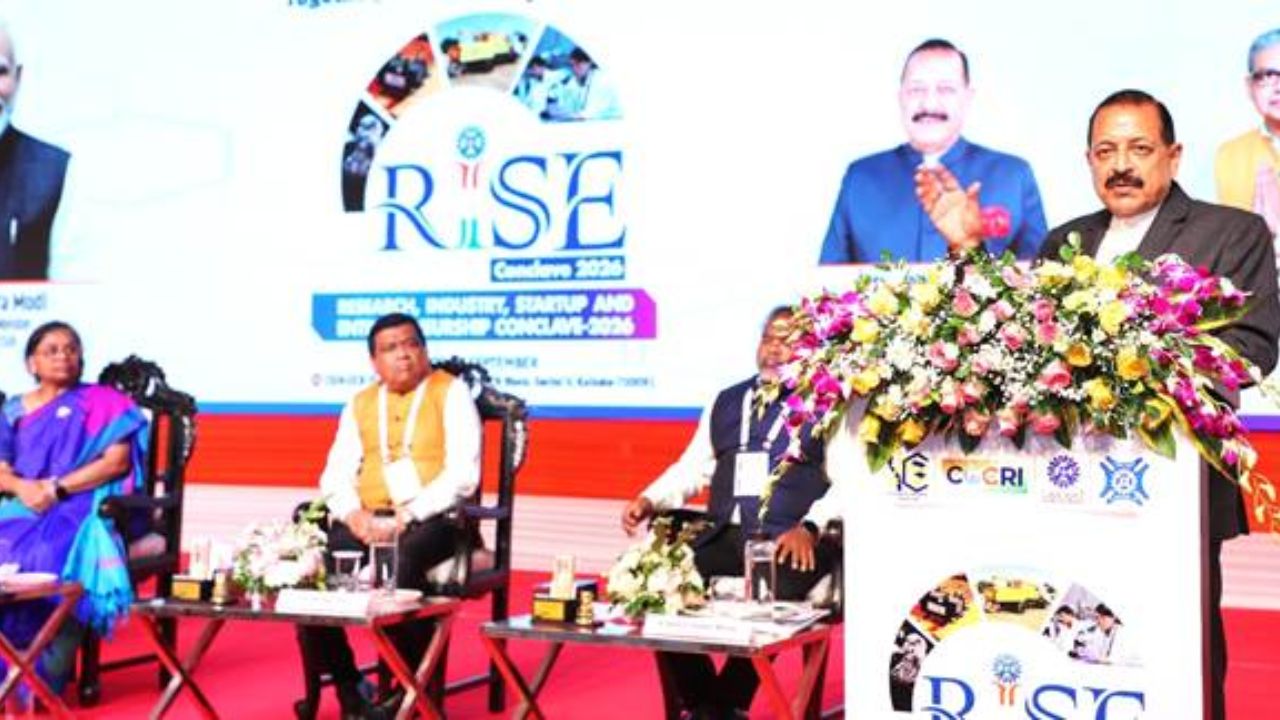

Union Minister of State (Independent Charge) for Science & Technology and Earth Sciences and MoS in the Prime Minister’s Office, Personnel, Public Grievances and Pensions, Atomic Energy and Space, Dr. Jitendra Singh has called for a stronger and more integrated partnership between industry and scientific research institutions to accelerate the journey of technologies from laboratories to the market.
Addressing an interaction with industry leaders, including CEOs, CSOs and COOs, during the 6th RISE Conclave at CSIR-Indian Institute of Chemical Biology (CSIR-IICB), Kolkata, the Minister said commercial partners should be identified and involved from the earliest stage of research projects.
Industry Participation Needed at Research Stage
Dr. Jitendra Singh stressed that involving industry only after a technology has been developed can result in delays and costly modifications. Instead, potential commercial partners should participate during project planning so that market demand, user expectations and commercial considerations are incorporated into the technology from the beginning.
Responding to an industry suggestion that companies should be associated with laboratories at an early stage, the Minister said such collaboration would enable researchers to receive practical inputs on product design, environmental sustainability, supply chains, market trends and commercial feasibility.
According to him, early engagement would reduce the possibility of a technology reaching the market only to require substantial changes to meet real-world requirements.
Focus on Critical Minerals and Indigenous Technologies
The interaction also provided industry representatives an opportunity to present specific technological challenges and requirements before the Minister. Critical minerals emerged as one of the key areas of discussion.
Industry participants highlighted the need to strengthen indigenous capabilities in areas such as rare-earth extraction, permanent magnets, lithium beneficiation and recycling. Technologies for recovering strategic minerals, including vanadium and titanium, were also discussed.
Industry representatives sought technological support from CSIR laboratories to scale up these technologies. Discussions also explored the potential for identifying and developing critical mineral resources in eastern India.
Dr. Jitendra Singh emphasised that India should make greater use of the capabilities being developed across CSIR laboratories and other government scientific institutions to address strategic industrial requirements.
Support for Space and Foundry Sectors
The Minister also took note of industry concerns related to space technology and specialised optical components. He sought further details on the issues raised and indicated that relevant matters could be taken up with the Department of Space.
The foundry sector also emerged as an area requiring stronger collaborative research infrastructure. Dr. Jitendra Singh suggested examining the possibility of establishing a common R&D facility for the sector.
He encouraged industry players to collectively identify their technological requirements and approach the government with a concrete proposal. The government, he said, would be prepared to facilitate an appropriate platform.
He similarly urged companies in the steel sector to work together and develop a common mechanism for addressing their research and technology needs.
Indigenous Antivenom Production Discussed
Bengal Chemicals and Pharmaceuticals raised the possibility of restoring indigenous production of anti-snake venom, highlighting the distinct snake species and requirements prevalent in eastern India.
Dr. Jitendra Singh advised the company to coordinate with the West Bengal Health Ministry and ensure that any proposed initiative is aligned with scientific standards and public-health requirements.
A startup working in the snakebite and venom sector also presented technologies aimed at identifying the species responsible for a snakebite and developing new antivenom solutions.
While appreciating the innovation, the Minister stressed that such technologies must undergo rigorous scientific validation and clinical trials before being adopted widely. He underlined that patient safety must remain paramount and advised the innovators to work with the West Bengal Health Ministry for the required validation.
Government Offers Continued Industry Engagement
Throughout the interaction, Dr. Jitendra Singh encouraged industry representatives to move beyond broad discussions and clearly articulate specific technological challenges for which government laboratories and scientific agencies could provide support.
He assured participants that appropriate linkages between industry and research institutions would be facilitated, while also encouraging companies to remain engaged beyond formal conclaves and meetings.
The 6th RISE Conclave consequently highlighted a collaborative approach in which industry participates from the beginning of the R&D process, scientific institutions provide technological expertise and the government acts as an enabler.
Such an ecosystem, Dr. Jitendra Singh emphasised, can help ensure that promising technologies are designed with real-world requirements in mind and move more efficiently from laboratories to commercial markets and wider societal applications.
Also Read: Tripura’s Organic Ethnic Rice Heads to European Markets with APEDA Support

Author: Shivam
Shivam Dwivedi is a senior journalist with extensive experience in research-driven journalism, policy communication, and multi-platform storytelling. His areas of interest include international relations, defence, science & technology, education, urban development, agriculture, spirituality, and environmental sustainability. His work focuses on in-depth analysis, public discourse, and impactful narratives across governance and development sectors, with a strong commitment to the Sustainable Development Goals (SDGs). Contact: [email protected]