
India has achieved a major milestone in sustainable road construction with the successful use of processed steel slag aggregates, a technology that can reduce construction costs by nearly 40 per cent while offering significantly higher strength than conventional road-building methods.
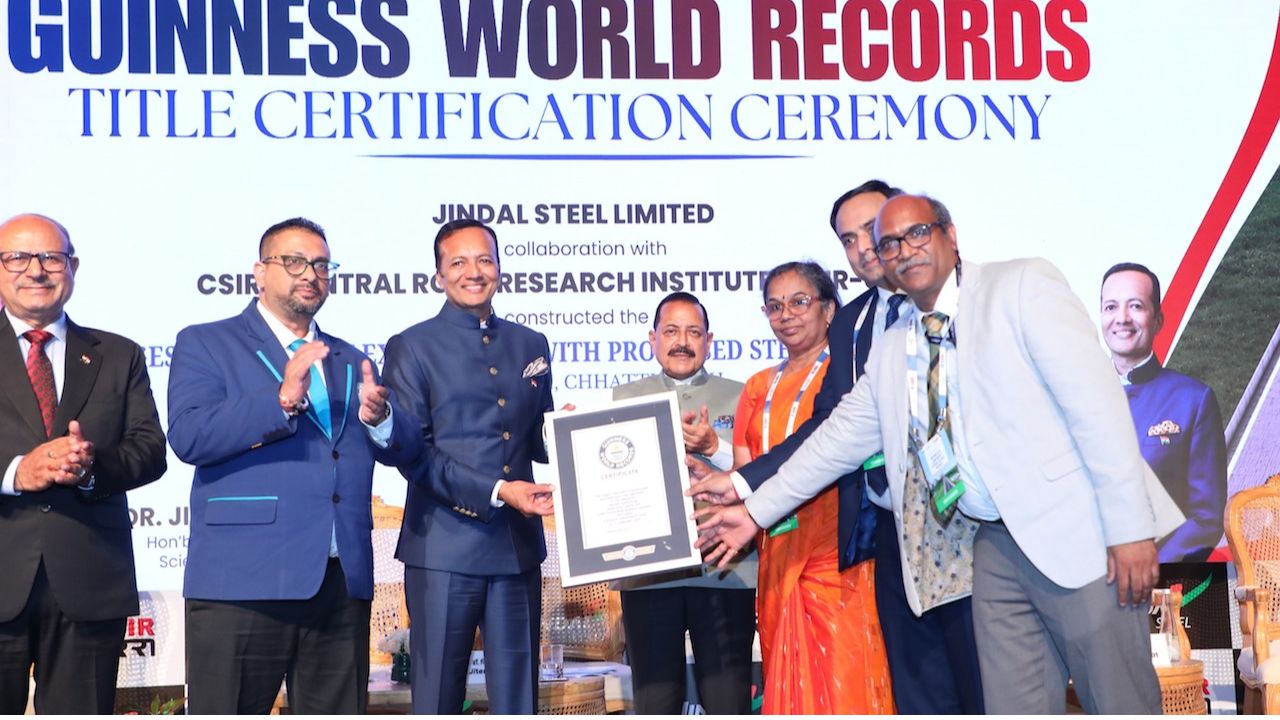
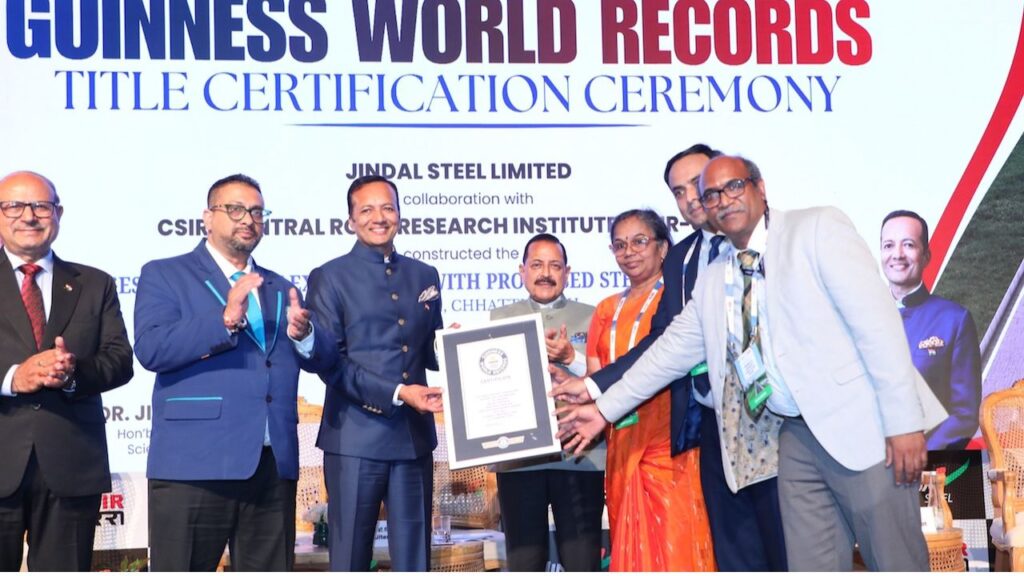
Union Minister of State (Independent Charge) for Science & Technology and Earth Sciences, Dr Jitendra Singh, highlighted the potential of the technology while attending the conferment of the Guinness World Record for the “World’s Longest Road Built with Processed Steel Slag Aggregates.”
1.85-Km Road Sets Guinness World Record
The record was achieved for a 1.85-kilometre road constructed in Raigarh, Chhattisgarh, through collaboration between CSIR-Central Road Research Institute (CSIR-CRRI) and Jindal Steel Limited. The project demonstrates how an industrial by-product can be processed and converted into useful construction material.
Dr Jitendra Singh said the technology can provide around four times the strength of conventional roads and, in suitable applications, significantly increase the maintenance cycle. Roads constructed using the technology may require maintenance only after around 15 years, offering potential savings in both construction and long-term infrastructure maintenance.
The event also featured the virtual inauguration of the road, release of a documentary on the technology, signing of a Technology Transfer Agreement between CSIR-CRRI and Jindal Steel, and the launch of the “Steel Grit” brand.
From Waste to Infrastructure Resource
Dr Jitendra Singh described the initiative as a practical example of the Government’s “Waste to Wealth” approach. He said the growing demand for highways, expressways, industrial corridors, ports and urban infrastructure has increased the need to conserve natural aggregates obtained through mining and quarrying.
Processed steel slag offers a dual benefit by reducing the amount of industrial waste requiring disposal while providing an alternative source of aggregates for infrastructure development. The Minister said the initiative demonstrates how Indian science, research and industry can work together to convert waste material into economic and infrastructure value.
He also stressed that the technology should move beyond individual demonstration projects. Calling for wider adoption, he urged stakeholders to take the innovation “from one project to many projects” and “from one State to many States.”
Potential for Challenging Geographies
The technology could be particularly useful in areas where conventional road construction faces durability challenges. Dr Jitendra Singh referred to regions with heavy rainfall, including parts of the Northeast, where construction opportunities can be limited to only a few months each year.
He also pointed to the changing traffic requirements of rural roads. Roads initially designed for light vehicles may later experience heavy commercial traffic as nearby areas develop into industrial or economic centres. More durable pavement technologies can help address such changing requirements and reduce repeated repair costs.
The Minister called for greater awareness among Railways, Central and State Government departments, private builders, contractors and infrastructure operators so that the technology can be considered wherever it is technically and economically appropriate.
Technology Expanding Across India
Processed steel slag aggregates have already been used in several infrastructure projects. Applications include a six-lane road near Hazira Port in Gujarat, a section of the NH-66 Mumbai-Goa Highway and heavy-duty road infrastructure in Arunachal Pradesh.
A 1.1-kilometre steel slag road has also been developed inside Hazira Port, demonstrating the material’s potential in demanding industrial and logistics environments when appropriate processing, pavement design and quality-control measures are followed.
40-Km Odisha Project Next
The Guinness World Record is expected to be followed by an even larger implementation. CSIR Director General and DSIR Secretary Dr N. Kalaiselvi announced that CSIR-CRRI has received a work order for a 40-kilometre road in Odisha from Jindal Steel’s Angul plant.
She said the new project could take the technology well beyond its current record and potentially enable CSIR-CRRI and Jindal Steel to establish a new benchmark.
Dr Jitendra Singh said the Guinness recognition should be viewed as the beginning rather than the end of the initiative. He emphasised that the ultimate objective is to transform successful indigenous innovations into mainstream infrastructure solutions.
The Steel Slag Road initiative thus represents a convergence of scientific innovation, industrial collaboration, waste management and sustainable infrastructure, offering India an opportunity to build stronger and more resource-efficient roads while creating value from industrial by-products.
Also Read: India Poised to Lead Global Advanced Technology and Critical Minerals Landscape: Dr Jitendra Singh

Author: Shivam
Shivam Dwivedi is a senior journalist with extensive experience in research-driven journalism, policy communication, and multi-platform storytelling. His areas of interest include international relations, defence, science & technology, education, urban development, agriculture, spirituality, and environmental sustainability. His work focuses on in-depth analysis, public discourse, and impactful narratives across governance and development sectors, with a strong commitment to the Sustainable Development Goals (SDGs). Contact: [email protected]