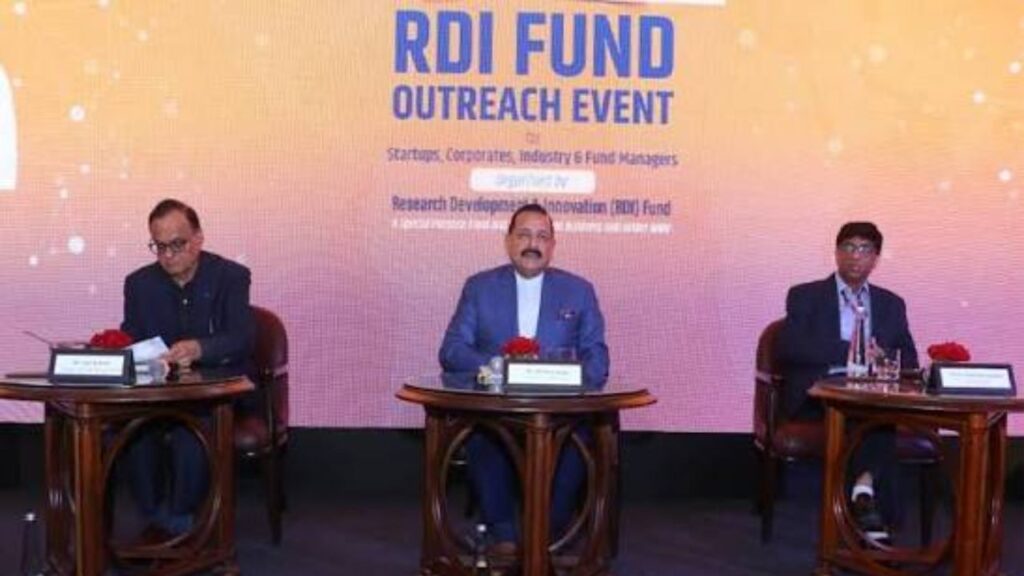

The Government has reiterated that the Research, Development and Innovation (RDI) Fund is being implemented through a transparent, merit-based and accountable framework, supported by strict conflict-of-interest (COI) safeguards. Officials from the Department of Science and Technology (DST), Technology Development Board (TDB) and Anusandhan National Research Foundation (ANRF) highlighted the institutional mechanisms ensuring fairness and integrity in the selection and funding of deep-tech projects.
Addressing a press conference on “Conflict-of-Interest Safeguards and Disbursement under the Research, Development and Innovation (RDI) Fund,” senior officials explained the governance structure, evaluation process and checks established to maintain public confidence in the Fund’s operations.
The briefing was addressed by Shri Rajesh Kumar Pathak, Secretary, Technology Development Board (TDB), and Dr. Shivkumar Kalyanaraman, Chief Executive Officer, Anusandhan National Research Foundation (ANRF). Prof. Umesh V. Waghmare, Secretary, Department of Science and Technology and Chairperson, TDB, joined virtually and reaffirmed the Government’s commitment to ethical governance, transparency and accountability.
Conflict-of-Interest Framework Ensures Fair Decision-Making
Officials clarified that the RDI Fund’s guidelines were designed to balance the need for specialised expertise with strict safeguards against conflicts of interest. Since experts capable of assessing advanced technologies often have prior associations with the innovation ecosystem, the framework allows participation of domain specialists while ensuring proper disclosures and restrictions.
The guidelines require members to declare any potential conflict, follow structured decision-making procedures and withdraw from discussions or voting whenever a conflict arises. Officials stressed that having professional or investment links with innovation entities does not automatically amount to a violation, provided the prescribed disclosure and recusal mechanisms are followed.
TDB has also introduced additional safeguards, including a provision that if an Investment Committee (IC) member is a founder, CEO or shareholder of an enterprise, that member must ensure that the concerned enterprise does not submit project proposals to TDB during the member’s tenure on the committee.
Independent Evaluation Process for Project Selection
The Government stated that project approvals under the RDI Fund are based on collective decisions taken by an Investment Committee consisting of independent experts from technology, industry and investment sectors.
Government representatives do not determine the technical merit of proposals, while the Member Secretary of TDB does not hold voting rights in the Investment Committee. Proposals are recommended only through a supermajority decision of eligible members, providing additional protection against individual influence.
Members who disclose a conflict are excluded from discussions and voting related to the concerned proposals. The Investment Committee’s recommendations are subsequently considered for final approval by the TDB Board.
Officials also highlighted that TDB has followed similar conflict-of-interest practices for nearly three decades. Established under an Act of Parliament in 1996, TDB has traditionally relied on expert committees rather than individual officials for evaluating technology proposals.
Funding Focused on Technology Projects, Not Companies
The Government clarified that RDI Fund assistance is provided for specific research and technology development projects rather than direct financial support to companies. Through TDB, assistance is extended mainly in the form of soft loans linked to approved technology projects.
Only eligible expenses incurred after proposal submission are considered, while earlier expenditure is excluded. Government support is released against matching investments mobilised from eligible non-government sources after project approval, ensuring that public funding encourages additional private investment.
Officials further explained that previous investments made by venture capital firms, angel investors or other private entities do not influence Government funding decisions. The assessment process focuses solely on scientific merit, technological innovation and the potential impact of the proposed project.
Supporting India’s Deep-Tech Innovation Ecosystem
Officials noted that the 22 companies selected under the current funding round are focused on deep-science technologies aimed at addressing critical challenges and developing sovereign solutions. Many of these innovations are being developed for the first time in India and are among a limited number of such technologies globally.
They added that early-stage deep-tech companies often face difficulties in accessing conventional debt financing. Private equity and angel investments received by these companies before approaching the RDI Fund have helped improve their chances of successful technology development.
Several approved projects had also undergone independent assessments through national innovation platforms and expert evaluation systems before being considered under the RDI Fund. Officials stated that some beneficiary companies had previously received project-based support from TDB, reflecting the organisation’s long-standing role in nurturing indigenous technologies.
Commitment to Deep-Tech Leadership
ANRF reiterated that conflict-of-interest management remains a central pillar of the RDI Fund’s governance model. The implementation guidelines require Second Level Fund Managers to establish Investment Committees with appropriate safeguards, including disclosure, recusal and transparent decision-making processes.
The Government emphasised that India’s goal of becoming a global deep-tech innovation leader requires participation from leading scientific, technological and investment experts. However, such expertise must operate within a framework that guarantees transparency and accountability.
Reaffirming its commitment to responsible public funding, the Government stated that all RDI Fund-supported projects are selected through a rule-based, transparent and merit-driven process. The safeguards of independent evaluation, mandatory disclosure, recusal and collective approval are intended to protect the integrity of the Fund while accelerating India’s research and innovation capabilities.
Also Read: CSIR-NIScPR Conducts Skill Training Programme on Science Communication and Emerging Trends