
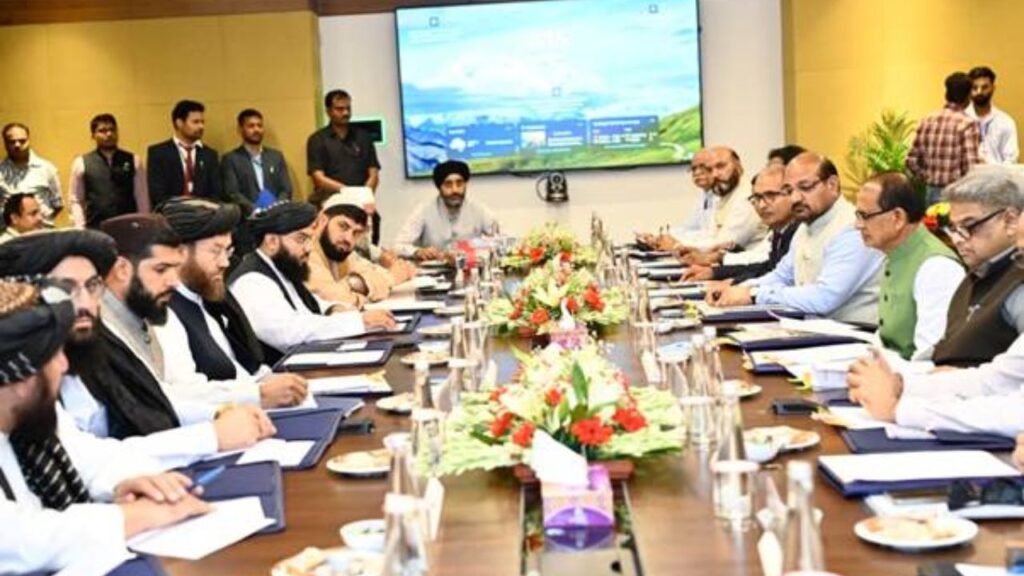

India and Afghanistan have reaffirmed their commitment to strengthening agricultural cooperation, with both countries agreeing to expand collaboration in areas ranging from food security and irrigation to agricultural research, education and agri-trade. The renewed partnership aims to improve farm productivity, promote sustainable agriculture and enhance the livelihoods of farmers in both nations.
The discussions took place during a bilateral meeting between Union Minister for Agriculture and Farmers’ Welfare and Rural Development Shri Shivraj Singh Chouhan and Afghanistan’s Minister of Agriculture, Irrigation and Livestock, H.E. Mawlawi Ataullah Omari, along with his delegation. Senior officials from the Ministry of Agriculture and Farmers’ Welfare and the Indian Council of Agricultural Research (ICAR) also participated in the meeting.
Shared Agricultural Vision
Welcoming the Afghan delegation, Shri Shivraj Singh Chouhan highlighted the centuries-old civilizational relationship between India and Afghanistan, emphasizing that the partnership is built on trust, friendship and strong people-to-people ties. He reiterated India’s commitment to supporting Afghanistan’s agricultural development by sharing scientific expertise, technological innovations and institutional experience.
The minister said India remains prepared to assist Afghanistan in improving agricultural productivity, ensuring food security and enhancing farmers’ incomes through collaborative initiatives.
Focus on Food Security and Improved Seed Systems
Food security emerged as one of the central themes of the discussions. Afghanistan underlined the importance of wheat as a staple crop and sought India’s support in increasing wheat productivity through better seed technologies and scientific cooperation.
Responding positively, India offered assistance in supplying quality wheat, maize and potato seeds, along with climate-resilient and biofortified crop varieties. India also proposed leveraging the expertise of ICAR institutions to strengthen Afghanistan’s seed systems, improve crop production and promote sustainable farming practices.
The collaboration is expected to help Afghanistan improve agricultural resilience while addressing challenges related to food availability and crop productivity.
Cooperation in Water Management and Climate Adaptation
Water scarcity and climate change were identified as major concerns affecting Afghanistan’s agricultural sector. During the meeting, the Afghan delegation sought India’s cooperation in irrigation management, water harvesting and watershed development.
Sharing India’s experience in sustainable water management, Shri Chouhan highlighted successful initiatives such as micro-irrigation, rainwater harvesting, farm ponds, check dams and efficient water-use technologies. He expressed India’s willingness to extend technical support for developing climate-resilient farming systems and sustainable irrigation infrastructure in Afghanistan.
The discussions reflected the growing importance of climate-smart agriculture in ensuring long-term agricultural sustainability across the region.
Expanding Research, Education and Capacity Building
The two sides also explored opportunities to deepen cooperation in agricultural research, education and human resource development. India proposed strengthening institutional partnerships between ICAR and Afghanistan’s agricultural institutions through joint research projects, faculty and student exchange programmes, laboratory support and specialised training for scientists, extension workers, veterinarians and agriculture professionals.
Both countries discussed collaboration in several emerging sectors, including horticulture, dairy farming, livestock development, poultry, fisheries, digital agriculture, post-harvest management and soil health improvement.
Such initiatives are expected to promote technology transfer, strengthen research capabilities and build technical expertise within Afghanistan’s agricultural ecosystem.
Boosting Agricultural Trade and Private Sector Participation
Enhancing bilateral agricultural trade also featured prominently in the discussions. Both countries acknowledged the potential for expanding trade in agricultural commodities, quality seeds and value-added farm products.
The Afghan side expressed interest in strengthening agricultural value chains, improving market access and encouraging greater private sector participation. Both governments agreed that stronger business-to-business partnerships could create new opportunities for farmers, exporters and agri-business enterprises in both countries.
Towards a Structured Partnership
During the meeting, ICAR officials presented an overview of the long-standing agricultural cooperation between India and Afghanistan, highlighting ongoing collaboration in agricultural research, irrigation, watershed development, germplasm exchange and human resource development.
The officials reaffirmed ICAR’s readiness to further expand cooperation in wheat research, horticulture, livestock, dairy, fisheries and agricultural technologies.
To institutionalise future collaboration, both countries agreed to work towards establishing a Joint Working Group that will prepare a structured roadmap for long-term cooperation in agriculture and livestock. The proposed mechanism will facilitate regular engagement between institutions and identify new areas of mutual interest.
Concluding the meeting, Shri Shivraj Singh Chouhan expressed confidence that the renewed partnership would strengthen the enduring friendship between India and Afghanistan while advancing sustainable agriculture, food security and farmer prosperity through research, innovation, technology transfer and capacity-building initiatives.

Author: Shivam
Proficient Writer Contact: [email protected]