

A team of Indian astrophysicists has made a significant breakthrough in understanding how massive solar eruptions evolve as they travel from the Sun to Earth, offering fresh insights that could improve forecasting of space weather events capable of disrupting satellites, GPS navigation, aviation, radio communications, and power grids.
Researchers from the Indian Institute of Astrophysics (IIA), Bengaluru, have carried out the first long-term statistical investigation into the thermal behaviour of Interplanetary Coronal Mass Ejections (ICMEs) near Earth. Their findings challenge the long-held assumption that these solar eruptions simply cool as they expand through space.
First Long-Term Analysis Across Three Solar Cycles
The study analysed nearly three decades of publicly available observations from 1995 to 2024, covering Solar Cycles 23, 24, and the rising phase of Solar Cycle 25. Led by doctoral scholar Soumyaranjan Khuntia and Associate Professor Wageesh Mishra, the research examined how the internal temperature and pressure of ICMEs change during their journey to Earth.
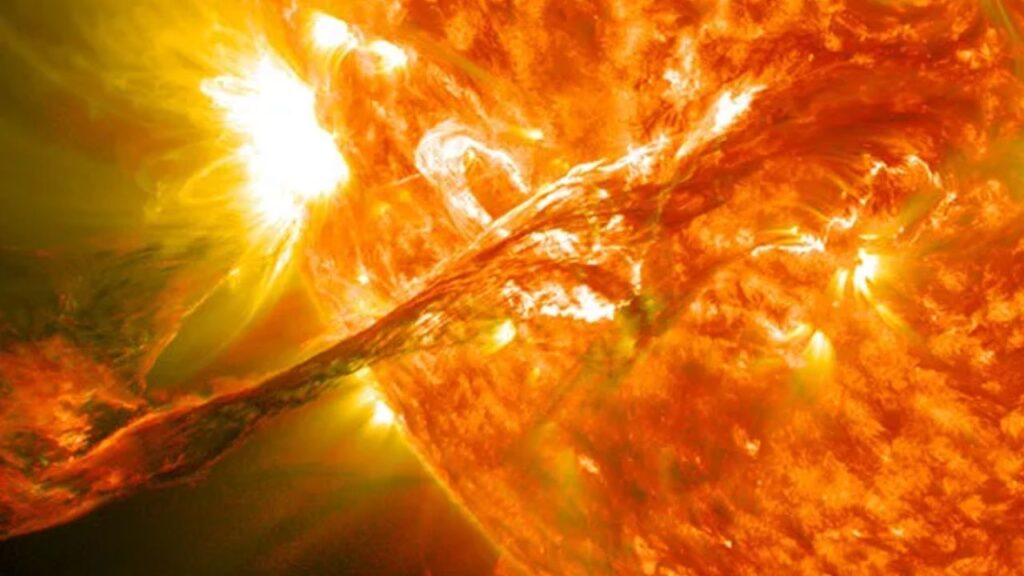
ICMEs are enormous clouds of magnetised plasma ejected from the Sun’s outer atmosphere. When directed toward Earth, they interact with the planet’s magnetic field and can trigger geomagnetic storms. Such storms have the potential to interfere with satellite operations, communication systems, navigation services, aviation routes, and electricity transmission networks while also producing spectacular auroras in Earth’s upper atmosphere.
The findings have been published in the journal Monthly Notices of the Royal Astronomical Society (MNRAS).
Challenging Conventional Understanding
Previous research largely focused on the speed, magnetic structure, or individual events associated with ICMEs. However, their thermal evolution during interplanetary travel remained poorly understood.
To address this gap, the IIA researchers used solar wind plasma measurements collected by spacecraft positioned near the Sun-Earth L1 Lagrange point, approximately 1.5 million kilometres from Earth. The data were sourced from NASA‘s OMNI database and CDAWeb repository, which provide comprehensive records of solar wind conditions near Earth.
The team applied a polytropic framework—a method that relates changes in pressure and temperature to changes in plasma density—to determine the thermal state of each ICME.
Their analysis revealed that nearly 45 per cent of magnetic ejecta exhibit heating signatures by the time they reach Earth’s orbit, particularly during periods of peak solar activity. This indicates that ICMEs remain thermodynamically active during their journey rather than simply cooling as they expand.
Solar Activity Influences ICME Heating
The researchers also discovered that the thermal behaviour of ICMEs changes with the Sun’s activity cycle.
According to the study, Solar Cycle 23 witnessed a greater number of heating-like events, while Solar Cycle 24 showed a stronger tendency toward cooling-dominated states. This variation suggests that the broader magnetic environment of the Sun plays an important role in determining how these massive plasma clouds evolve before reaching Earth.
The findings provide new evidence that solar activity influences not only the frequency of ICMEs but also their internal thermodynamic characteristics.
Stronger Storms Linked to Heating States
Another key outcome of the research is the established relationship between an ICME’s thermal condition and its ability to generate severe geomagnetic storms.
The study found that the most geoeffective solar storms are typically associated with ICMEs that remain in a heating state. These events are characterised by stronger magnetic fields, lower plasma beta values—indicating dominance of magnetic pressure—compressed sheath regions, and faster expansion speeds.
By combining thermal and magnetic properties, scientists believe they can develop a more comprehensive framework for assessing the potential impact of incoming solar storms.
Lead author Soumyaranjan Khuntia said that understanding the thermal evolution of ICMEs opens new possibilities for predicting space weather. He noted that if thermal indicators such as the polytropic index can be identified through remote sensing or early observations, they could serve as valuable precursors for estimating the severity of approaching geomagnetic disturbances.
Associate Professor Wageesh Mishra added that the polytropic index has emerged as an important diagnostic tool for understanding the thermal state of ICMEs and their influence on Earth’s geomagnetic environment. When combined with measurements of plasma and magnetic field properties, it can significantly improve forecasts of severe space weather events.
Looking ahead, the research team plans to integrate observations from India’s Aditya-L1 solar mission. Data from the mission’s coronagraph and solar wind instruments are expected to help scientists track the thermal evolution of coronal mass ejections much closer to the Sun, paving the way for more accurate and timely space weather prediction systems.

Author: Shivam
Proficient Writer Contact: [email protected]