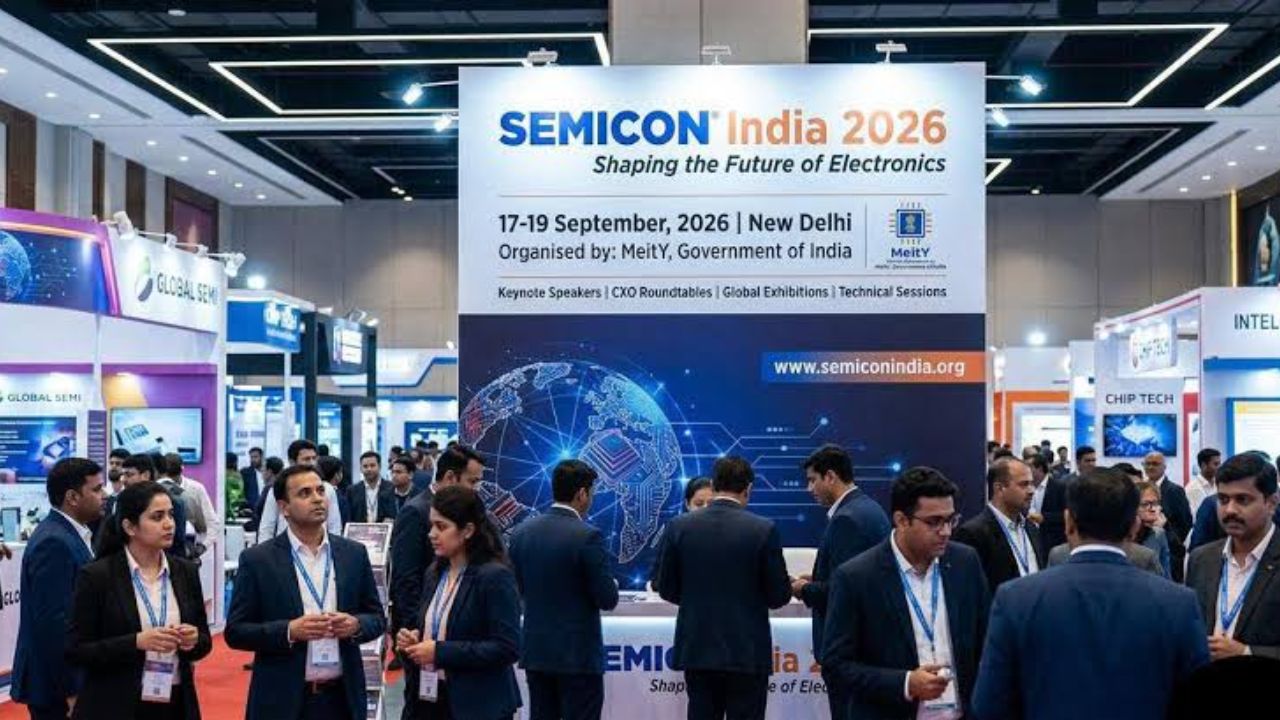

SEMICON India 2026, the fifth edition of India’s flagship semiconductor event, concluded at Yashobhoomi, New Delhi, after three days of discussions, partnerships and technology showcases aimed at strengthening the country’s semiconductor capabilities. Held from September 17 to 19 under the theme “Silicon to Systems: Building the Ecosystem,” the event brought together global semiconductor companies, policymakers, startups, researchers, students and industry stakeholders.
The 2026 edition witnessed participation from more than 600 exhibitors, including nearly 300 international participants, representing 52 countries. Six country pavilions from Japan, South Korea, Malaysia, the Netherlands, Singapore and Sweden, along with 12 state pavilions, displayed technologies and opportunities across the semiconductor value chain. The event recorded 51,656 registrations and approximately 40,000 visitors.
Prime Minister Narendra Modi inaugurated the conference and highlighted the progress made by India in moving from semiconductor policy formulation and project approvals towards commercial production. During the event, he interacted with young chip designers and students and virtually inaugurated commercial production lines at CDIL Semiconductor in Mohali and Suchi Semicon in Surat. With these facilities becoming operational, the number of commercial semiconductor units among the 12 projects approved under Semicon 1.0 reached five.
The Prime Minister also outlined the next phase of the national semiconductor programme, Semicon 2.0, which carries an outlay of ₹1,27,500 crore. The programme is structured around six broad areas covering semiconductor design, machines and materials, new fabrication facilities, advanced packaging, research and talent development, with the objective of expanding capabilities across the value chain.
Over the three-day conference, 56 MoUs, announcements and strategic initiatives were unveiled. These covered semiconductor design, fabrication, advanced packaging, equipment and materials, power electronics, artificial intelligence, high-performance computing, research and development, logistics, technology commercialisation and workforce development.
The second day focused on expanding the semiconductor ecosystem beyond fabrication capacity. Union Minister for Electronics and Information Technology, Railways, and Information & Broadcasting Ashwini Vaishnaw discussed the implementation framework for Semicon 2.0, emphasising design, manufacturing equipment, materials, fabs, advanced packaging, applied research and skilled talent.
Sessions also examined resilient supply chains, AI-driven chip design, indigenous research, power electronics, display technologies and greater participation of women in semiconductor manufacturing. Industry experts stressed the importance of developing supporting capabilities in precision manufacturing, gases, chemicals, equipment, intellectual property and specialised human resources.
The concluding day focused on technology development, investment facilitation, sustainable manufacturing, advanced displays, workforce preparation and deep-tech entrepreneurship. The Leadership Forum highlighted the importance of connecting chip design and fabrication with materials, equipment, packaging and electronics systems to create an integrated semiconductor ecosystem.
Indigenous innovation was another major focus. The Digital India RISC-V Grand Challenge, conducted under the Chips to Startup Programme, attracted 1,236 teams comprising 5,045 participants. Top teams were recognised for developing solutions using indigenous VEGA and SHAKTI processor-based system-on-chips.
Three hackathons organised by KLA, Synopsys and Lam Research in collaboration with CeNSE-IISc recorded more than 3,800 team registrations from over 900 colleges. The initiatives provided students with opportunities to work on industry-oriented semiconductor challenges, with winners receiving prizes, internships, software tools and compute credits.
International cooperation remained central to the event through six country roundtables involving the United States, Japan, Singapore, Europe, South Korea and Malaysia. Discussions explored investment, technology partnerships, advanced packaging, equipment and materials, research, supply chains and talent development.
SEMICON India 2026 thus brought together the different components of India’s semiconductor ambitions—from design and intellectual property to materials, fabrication, packaging, electronics manufacturing, research, startups and skilled manpower. The scale of participation and the range of partnerships demonstrated the growing focus on building an integrated semiconductor ecosystem capable of supporting both domestic requirements and global value chains.
Also Read: CBIC Launches Special Campaign 6 to Boost Cleanliness and Reduce Office Pendency

Author: Shivam
Proficient Writer Contact: [email protected]