
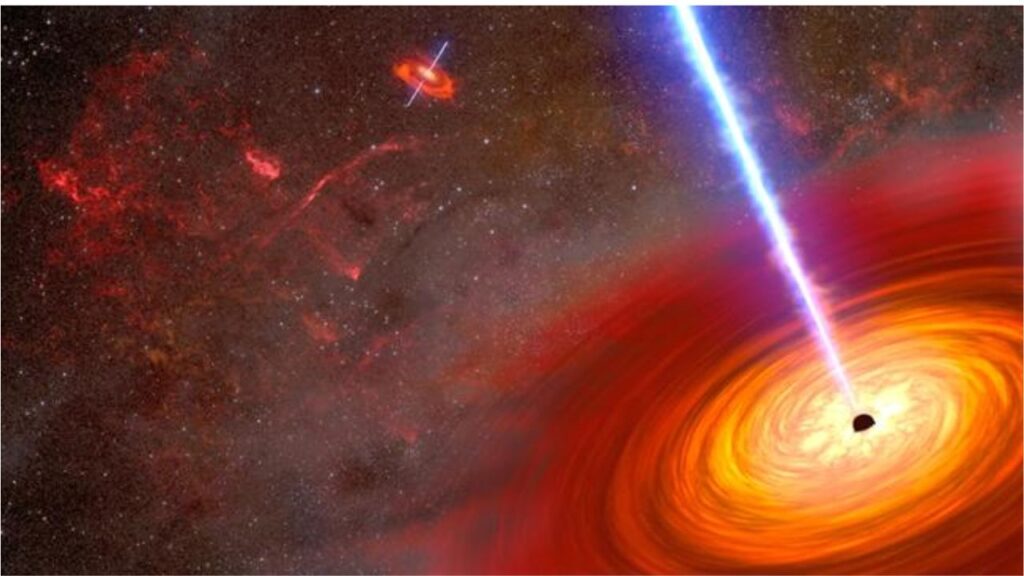

Astronomers have uncovered a hidden population of weakly active supermassive black holes in nearby galaxies, shedding new light on how black holes grow and influence the evolution of galaxies in the present-day Universe. The discovery, made through one of the most comprehensive high-resolution radio surveys of nearby galaxies, highlights the crucial role of advanced radio astronomy in detecting faint black hole activity that has long remained invisible to conventional observations.
The international study included Dr. Aru Beri of the Indian Institute of Astrophysics (IIA), an autonomous institute under the Department of Science and Technology (DST). The findings have been published in the Monthly Notices of the Royal Astronomical Society.
Looking Beyond Bright Black Holes
Scientists have long believed that nearly every galaxy hosts a massive black hole at its centre. While some of these black holes are extremely active and emit enormous amounts of energy, many remain relatively quiet, making them difficult to identify using traditional observational methods.
Despite their faint appearance, these weakly active black holes can significantly influence their host galaxies. They release energy through jets and outflows that interact with surrounding gas, affecting the rate at which new stars form and shaping the long-term evolution of galaxies.
Identifying these elusive objects has remained a major challenge because their weak emissions are often overwhelmed by radiation from stars and other energetic processes occurring within galaxies.
High-Resolution Radio Survey Reveals Hidden Activity
To overcome these limitations, the research team used the enhanced Multi-Element Remotely Linked Interferometer Network (e-MERLIN), a high-resolution radio telescope array, to observe 280 nearby galaxies selected from the well-known Palomar sample.
The observations focused on the central regions of the galaxies at parsec-scale resolution, enabling astronomers to isolate radio signals originating from the immediate vicinity of their central black holes.
The survey detected compact radio emission from the centres of nearly one-quarter of the observed galaxies. These radio signatures indicate the presence of weakly accreting supermassive black holes that had largely escaped detection in previous studies.
Most of the detected sources appeared highly compact, suggesting activity confined to the immediate surroundings of the black holes. A smaller number displayed jet-like radio structures extending across several parsecs, providing further evidence of active energy release.
A More Complete Picture of Black Hole Growth
The study marks one of the first statistically complete high-resolution radio surveys capable of systematically identifying faint black hole activity in a large and carefully selected sample of nearby galaxies.
Earlier investigations often faced significant limitations. Many lacked the sensitivity and angular resolution needed to distinguish weak emissions from central black holes from nearby stellar activity. Others examined relatively small or potentially biased samples, making it difficult to draw broader conclusions.
By combining a large, representative galaxy sample with exceptionally high radio resolution, the researchers were able to build a more reliable picture of low-level black hole activity across the local Universe.
X-ray Observations Confirm the Findings
To validate the radio detections, the team complemented their observations with X-ray data obtained from NASA‘s Chandra X-ray Observatory.
The combined radio and X-ray analysis confirmed that the detected emissions originate from actively accreting supermassive black holes rather than other energetic sources within galaxies, such as star-forming regions, supernova remnants, or X-ray binary systems.
This multi-wavelength approach provided strong evidence that the observed radio signals truly represent black hole activity, significantly increasing confidence in the results.
Implications for Galaxy Evolution
The findings suggest that faint, low-level accretion may be the most common mode of black hole growth in the present-day Universe. Rather than growing only during dramatic, high-energy phases, many supermassive black holes may spend much of their lifetime accreting matter slowly while continuing to influence their surrounding environments.
The discovery also demonstrates the importance of high-resolution radio astronomy in uncovering populations of weakly active black holes that remain hidden in conventional galaxy surveys. As next-generation radio telescopes become operational, astronomers expect to identify many more such objects, helping refine models of black hole evolution and their role in shaping galaxies over cosmic time.
The research was led by D. R. A. Williams-Baldwin and an international team of collaborators, including Dr. Aru Beri from the Indian Institute of Astrophysics, underscoring India’s growing contribution to cutting-edge astronomical research.

Author: Shivam
Shivam Dwivedi is a senior journalist with extensive experience in research-driven journalism, policy communication, and multi-platform storytelling. His areas of interest include international relations, defence, science & technology, education, urban development, agriculture, spirituality, and environmental sustainability. His work focuses on in-depth analysis, public discourse, and impactful narratives across governance and development sectors, with a strong commitment to the Sustainable Development Goals (SDGs). Contact: [email protected]