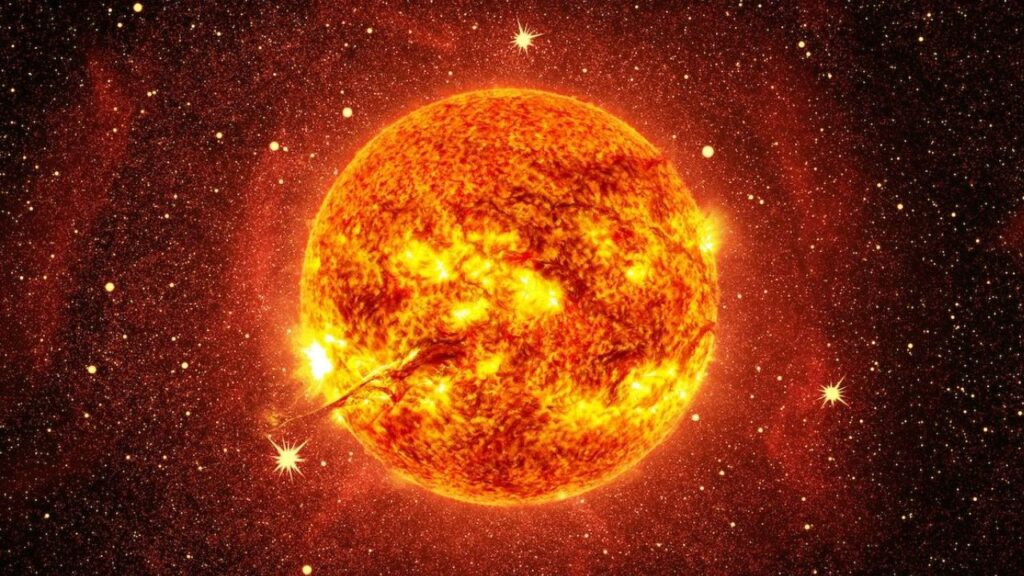

Artificial Intelligence (AI) has helped scientists unlock nearly a century of the Sun’s magnetic history by analysing hand-drawn solar observations from the Kodaikanal Solar Observatory (KoSO), offering fresh insights into how solar activity has evolved across multiple solar cycles.
The breakthrough study, led by researchers from the Aryabhatta Research Institute of Observational Sciences (ARIES), demonstrates how machine learning can transform historical astronomical records into valuable scientific datasets. By digitising and analysing hand-drawn solar charts spanning from 1916 to 2007, the researchers have created one of the longest continuous records of magnetically active regions on the Sun.
The findings, published in The Astrophysical Journal, could significantly improve scientists’ understanding of long-term solar behaviour and strengthen future space weather forecasting.
AI Breathes New Life into Historic Solar Records
For over a century, astronomers have observed that the Sun undergoes periodic cycles of magnetic activity, typically lasting around 11 years. During these cycles, the number of sunspots, solar flares, and magnetic eruptions rises and falls. These events can influence Earth’s technological systems, including satellite communications, GPS navigation, radio transmissions, and electrical power grids.
Studying long-term changes in solar activity, however, has remained a challenge because many early observations exist only as hand-drawn records. Variations in drawing styles, ageing paper, faded markings, and inconsistent scanning have made these historical archives difficult to analyse using conventional techniques.
The new study overcomes these limitations by employing artificial intelligence to convert archival drawings into machine-readable scientific data.
Century-Old Kodaikanal Archive Proves Valuable
The research was led by Dibya Kirti Mishra of ARIES, an autonomous institute under the Department of Science and Technology (DST), Government of India, in collaboration with scientists from the Indian Institute of Space Science and Technology (IIST), Thiruvananthapuram; the Southwest Research Institute, Boulder, USA; and the Indian Institute of Astrophysics (IIA), Bengaluru.
The team utilised KoSO’s unique collection of daily solar “suncharts,” which have been maintained from 1904 to 2022. These charts carefully document solar features such as sunspots, plages, filaments, and prominences on standardised grids, making them one of the world’s most comprehensive historical solar archives.
Machine Learning Identifies Solar Magnetic Activity
To extract useful information from the century-old drawings, the researchers adopted a supervised deep learning model known as U-Net.
The AI system first detected the exact position of the Sun’s disc in every scanned image by identifying its centre, size, and orientation. This ensured that every recorded solar feature could be accurately mapped onto the Sun’s surface despite variations in the original drawings.
The second stage focused on identifying and tracing solar plages—bright magnetically active regions associated with strong magnetic fields. These features serve as reliable indicators of the Sun’s magnetic behaviour.
Using AI, the researchers successfully tracked these magnetic regions across nine solar cycles between 1916 and 2007.
Butterfly Diagram Reveals Solar Cycles
The extracted data enabled the scientists to generate a detailed time-latitude “butterfly diagram,” a visual representation showing how magnetic activity migrates across solar latitudes during successive solar cycles.
The AI-generated results closely matched observations obtained independently from KoSO’s calcium (Ca II K) full-disc solar images, providing strong validation for the machine learning approach.
This agreement also shows that the hand-drawn records can fill important gaps in observational datasets, allowing scientists to reconstruct a more complete history of the Sun’s magnetic evolution.
Strengthening Space Weather Research
Understanding the Sun’s long-term magnetic behaviour has become increasingly important as modern societies grow more dependent on space-based technologies.
Solar eruptions can interfere with satellite operations, aviation communication, navigation systems, and power infrastructure. Reliable historical datasets enable researchers to compare the intensity and structure of different solar cycles, improve models of the Sun’s changing magnetic output, and refine long-term space weather predictions.
The study also highlights how artificial intelligence can preserve and revitalise scientific heritage by converting historical observations into reliable digital datasets.
Researchers believe similar AI-based techniques could be applied to other astronomical archives around the world, opening new opportunities to study long-term changes in celestial phenomena that were previously hidden within handwritten records.
By combining modern machine learning with over a century of careful human observations, the study provides a powerful example of how historical science and artificial intelligence can work together to deepen our understanding of the dynamic star that sustains life on Earth.