
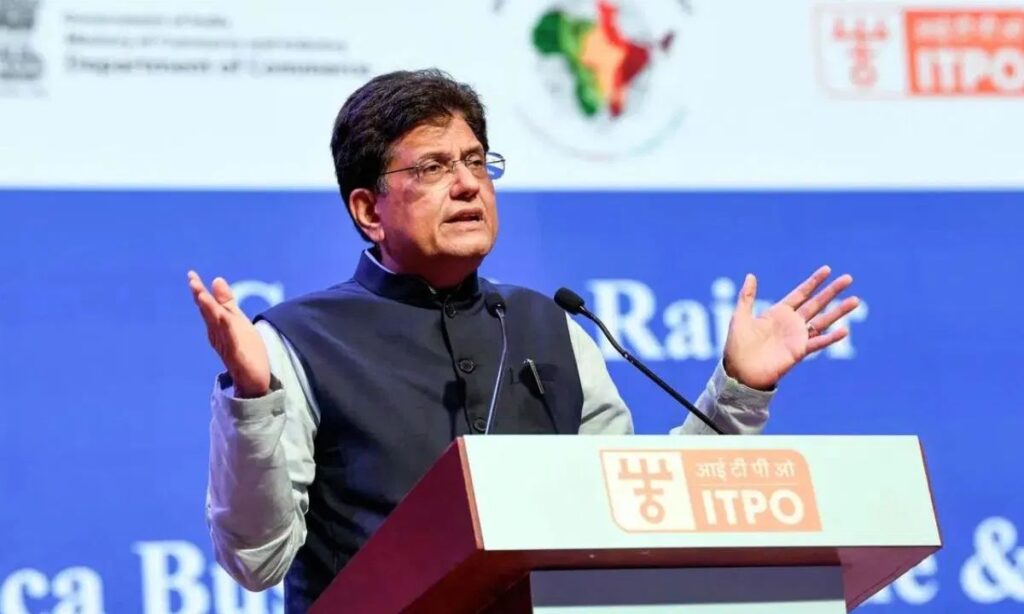

Commerce Minister Piyush Goyal on Tuesday urged Indian industries to fully utilise the opportunities emerging from India’s expanding network of free trade agreements (FTAs) to boost exports, attract investments, and strengthen the country’s global competitiveness rather than allowing imports alone to rise.
Speaking at ASSOCHAM’s India Business Reform Summit in New Delhi, Goyal said Indian businesses must proactively engage with international markets and prepare themselves to take advantage of new trade arrangements that are expected to come into force in the coming months.
“Unless Indian industries strengthen global engagements, invite investments, and promote exports, we can jolly well end up in a situation where more imports come in,” the minister said.
His remarks come ahead of the expected implementation of India’s free trade agreement with Oman on June 1. India is also expected to operationalise trade agreements with the United Kingdom, the European Union, and New Zealand later this year, significantly expanding market access opportunities for Indian exporters.
Goyal said the country would witness a steady flow of trade agreements over the next few years and urged exporters to begin building relationships with overseas buyers even before the agreements officially become operational.
“Every few months an FTA will come into force,” he said, suggesting that exporters should begin sampling, trial orders, and business engagements early to secure long-term partnerships in global markets.
The minister acknowledged that India’s past experience with several trade agreements has shown imports often rising faster than exports. He pointed to agreements with the United Arab Emirates (UAE), ASEAN countries, and South Korea as examples where trade imbalances widened after implementation.
According to government estimates, India’s exports to the UAE have increased by nearly $13 billion over the past four years, but imports have risen by around $24 billion during the same period. Similarly, India’s trade deficit with ASEAN nations and South Korea has grown significantly, prompting the government to seek a review of those agreements.
Goyal stressed that future FTAs should deliver stronger gains for Indian manufacturing and value-added exports. He identified sectors such as automobiles, auto components, electronics, consumer goods, and finished products as key areas where India has strong export potential.
“I am looking for greater exports in value-added products, automobiles, and auto components. We are looking for greater exports in electronics finished goods and consumer goods,” he said.
At the same time, the minister clarified that not all imports should be viewed negatively. He said India would continue to require imports of high-quality precision products and advanced industrial goods that support domestic manufacturing and economic expansion.
“If we need high-quality precision goods, they will need to be imported. They are enablers for India’s growth story, and I don’t think we should be worried about such productive imports,” Goyal noted.
The minister also urged businesses to view the current global geopolitical tensions and economic uncertainties as an opportunity for India to become more resilient and globally competitive. He called on industries to strengthen supply chains, improve operational efficiency, and accelerate reforms to position India as a trusted global manufacturing and export hub.
Industry experts believe India’s upcoming FTAs could significantly boost exports if domestic companies scale up competitiveness, innovation, and supply chain integration alongside improved market access.

Author: Shivam
Proficient Writer Contact: [email protected]