
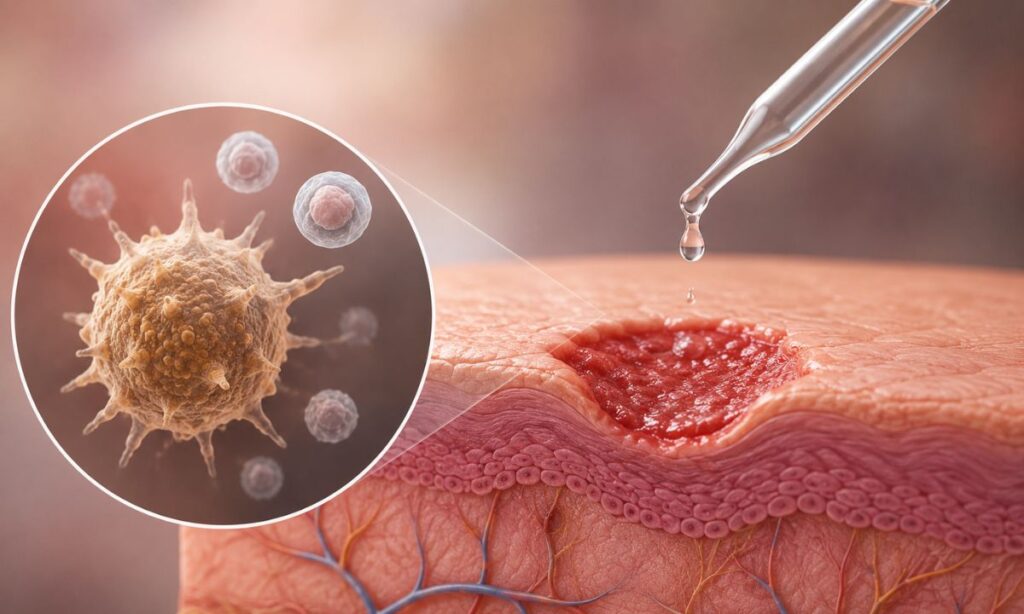

Scientists have reported a promising breakthrough in wound-healing research after discovering that a drug designed to remove aging “zombie cells” significantly improved skin repair in older mice. The findings suggest that future treatments targeting these dysfunctional cells could help elderly patients recover faster from surgery, injuries, and chronic wounds.
The study, published in the journal Aging (Aging-US), was conducted by researchers from the Boston University Aram V. Chobanian and Edward Avedisian School of Medicine and several collaborating institutions. Scientists tested a senolytic drug called ABT-263, which is designed to selectively eliminate senescent cells – damaged aging cells that stop functioning normally but refuse to die.
These senescent cells, often referred to as “zombie cells,” accumulate in tissues as the body ages. Although inactive, they continue releasing inflammatory molecules that weaken surrounding tissue, slow healing, and contribute to age-related decline. Researchers believe their buildup is one reason older skin heals much more slowly after injury.
Instead of administering the drug orally, researchers applied ABT-263 directly to the skin of aged mice for five days. The results were striking. After treatment, the skin showed significantly fewer markers of cellular aging. Scientists then created small wounds in the mice to test healing speed.
By day 24, around 80 percent of the treated mice had fully healed wounds, compared to only 56 percent of untreated mice. Researchers also observed that toxic age-related proteins were cleared more efficiently, while tissue repair pathways became more active.
One unexpected finding was that the treatment briefly increased inflammation in the skin. However, scientists said this short-term inflammatory response appeared beneficial rather than harmful. It activated healing-related genes involved in collagen production, blood vessel growth, and tissue remodeling – all essential processes for wound recovery.
Researchers noted that aging skin does not only become thinner or wrinkled over time. It also loses its ability to respond efficiently after injury, increasing the risk of delayed healing, surgical complications, and chronic wounds in elderly individuals.
The study also highlighted the advantages of localized treatment. Oral senolytic drugs can circulate throughout the body and potentially cause side effects, while topical application allows the therapy to target damaged skin directly. Interestingly, the treatment appeared to work mainly in older tissue, where senescent cells had accumulated, and showed little effect in young mice.
Researchers believe the approach could eventually be used before surgery to prepare older skin for faster recovery. “Our study underscores the potential of topical senolytic treatments to enhance wound healing in aging skin,” the researchers stated.
Recent studies are also supporting the broader idea of localized senolytic therapies. A 2026 study involving diabetic wound healing found that a wound dressing containing ABT-263 improved healing in diabetic mice without detectable systemic toxicity. Scientists say this could open new possibilities for treating chronic wounds and age-related skin disorders.
Despite the encouraging results, experts caution that the research remains at an early stage. The experiments were conducted only in mice, and many treatments that succeed in animal studies fail during human clinical trials. Researchers say further studies are needed to determine safety, proper dosing, long-term effects, and effectiveness in humans.
Still, scientists believe the findings represent an important step toward therapies that could help aging skin recover faster and more effectively by removing the damaged cells that interfere with the body’s natural repair systems.