
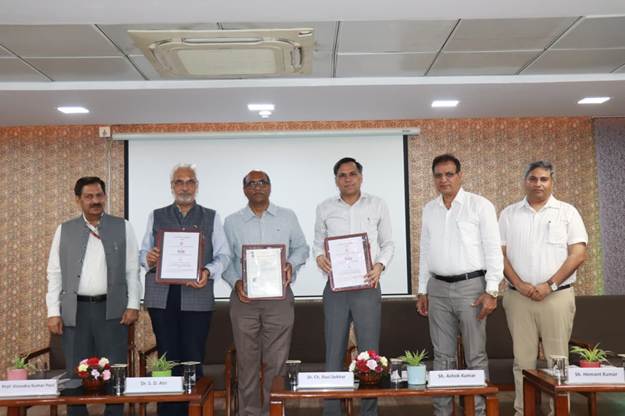

In a significant move aimed at combating road dust pollution and improving air quality in the National Capital Region (NCR), the CSIR-Central Road Research Institute (CSIR-CRRI) has signed a Memorandum of Agreement (MoA) with the Government of Haryana to implement a comprehensive framework for paving and greening urban roads across the state.
The agreement was signed at CSIR-CRRI headquarters in New Delhi under the project titled “Implementation of the Standard Framework for Paving and Greening of Urban Roads (Haryana State).” The initiative is expected to play a crucial role in developing sustainable urban infrastructure while addressing one of the major sources of particulate air pollution in the NCR.
The project will be jointly executed by CSIR-CRRI and the School of Planning and Architecture (SPA), New Delhi, in collaboration with the Haryana Government. The implementation will be carried out under the guidance of the Commission for Air Quality Management (CAQM), which has been actively working to improve air quality across the region.
Speaking at the event, Dr. Ch. Ravi Sekhar, Director of CSIR-CRRI, emphasized the importance of adopting science-based and technology-driven solutions to tackle road dust pollution. He noted that road dust remains a major environmental challenge in urban areas and highlighted the institute’s commitment to developing practical measures that contribute to cleaner and healthier cities.
Prof. Virendra Kumar Paul, Director of SPA New Delhi, stressed the need for integrated planning approaches in urban development. He said that sustainable road infrastructure requires coordinated efforts in design, planning, and implementation to ensure long-term environmental benefits and improved urban mobility.
Representing the Haryana Government, Ashok Kumar, IAS, Commissioner and Secretary of the Urban Local Bodies Department, expressed confidence in the collaborative initiative. He appreciated the efforts of CSIR-CRRI, SPA New Delhi, and CAQM in creating a robust framework for road dust mitigation and reaffirmed the state’s commitment to implementing the recommendations effectively.
Dr. S. D. Atri, Member (Technical) of CAQM, highlighted the growing concern over road dust emissions in the NCR. He stated that road dust is one of the leading contributors to particulate matter pollution and emphasized the need for coordinated action among research institutions, government agencies, and local bodies to achieve measurable improvements in air quality.
The MoA was formally exchanged in the presence of senior officials from CAQM, the Government of Haryana, CSIR-CRRI, and SPA New Delhi, marking the beginning of a structured implementation programme aimed at translating policy recommendations into on-ground action.
Road dust has long been recognized as a significant source of air pollution in urban areas. To address this challenge, CAQM had earlier issued a Standard Framework and Detailed Guidance Document for Paving and Greening of Urban Roads, developed on the basis of recommendations made by CSIR-CRRI. The newly signed agreement seeks to operationalize these guidelines throughout Haryana.
The project will focus on four key areas. These include the development of standardized road space norms and cross-sections, implementation of greening measures within road rights-of-way to reduce dust generation, strengthening road maintenance practices through a Road Asset Management System (RAMS), and promoting innovative technologies for road construction and upkeep.
Experts believe that these measures will not only reduce airborne dust but also improve road quality, enhance urban aesthetics, and support sustainable development goals.
The initiative represents a major milestone in the collective efforts of CSIR-CRRI, SPA New Delhi, CAQM, and the Haryana Government to build cleaner, greener, and more resilient urban environments. By combining scientific research, urban planning expertise, and administrative support, the programme is expected to contribute significantly to improving air quality and urban living conditions across the NCR.
The event concluded with a vote of thanks delivered by Dr. Vinod Karar, Scientist-G and Head of the Planning, Monitoring & Evaluation Division at CSIR-CRRI, followed by interactions among participants and stakeholders.

Author: Shivam
Proficient Writer Contact: [email protected]