
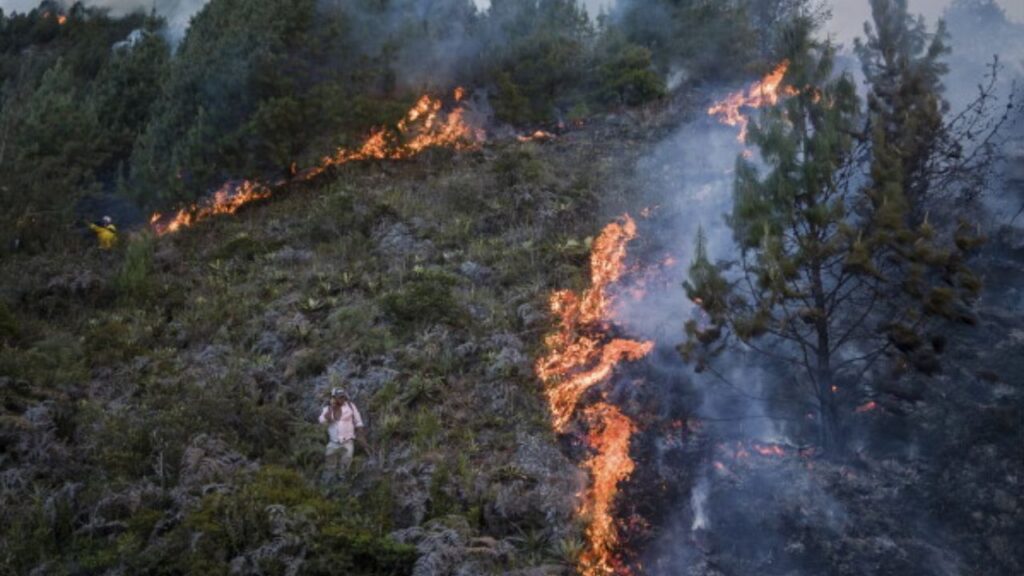

Scientists have uncovered compelling molecular evidence of massive wildfires that swept across the ancient Gondwana forests nearly 250 million years ago during the Permian period. The discovery provides new insights into how prehistoric fires influenced Earth’s climate, vegetation patterns, and coal-forming ecosystems long before the emergence of humans.
The breakthrough study was carried out by researchers from the Birbal Sahni Institute of Palaeosciences (BSIP), an autonomous institute under the Department of Science and Technology. Their findings have been published in the Geological Journal by Wiley.
For decades, scientists have attempted to reconstruct ancient wildfire events using fossil charcoal preserved in sedimentary rocks. Earlier investigations based on macrocharcoal in Indian Permian sediments had already indicated that widespread fire activity occurred across Gondwana landscapes. However, researchers faced major challenges in accurately distinguishing different forms of microcharcoal particles found in coal-bearing deposits.
Traditional studies relied heavily on microscopic observations, which often created uncertainty regarding whether the charcoal particles originated from wildfire activity or other natural geological processes. Two major forms of opaque phytoclasts — oxidized opaque phytoclasts (OX-CH) and fire-induced opaque phytoclasts (PAL-CH) — were particularly difficult to differentiate using visual methods alone.
To overcome this limitation, the BSIP research team adopted a novel multi-proxy scientific approach. The team, comprising researchers Neha Aggarwal, Shivalee Srivastava, and Runcie Paul Mathews, combined palynofacies analysis with advanced molecular techniques such as Raman spectroscopy and Fourier Transform Infrared (FTIR) spectroscopy.
Palynofacies analysis involves the study of microscopic organic particles preserved within sedimentary rocks and is widely used to reconstruct ancient environmental conditions. By integrating this technique with molecular-scale spectroscopy, the researchers were able to identify unique chemical signatures left behind by ancient combustion processes.
The study focused on Gondwana coal-bearing sediments from the Godavari Valley Coalfield in India, one of the country’s major geological repositories of Permian-age deposits. Through detailed analysis, the scientists successfully distinguished between high-intensity and low-intensity palaeofire-derived microcharcoal particles.
The high-intensity fire particles, referred to as h-PAL-CH, displayed distinct structural and optical characteristics compared to low-intensity fire particles, or l-PAL-CH. These differences were identified through variations in morphology, preservation state, and molecular composition.
One of the most significant findings came from Raman spectroscopy, which revealed well-developed second-order spectral features linked to structural ordering in carbonaceous material. These features are associated with polyaromatic hydrocarbons (PAHs), compounds typically generated during intense combustion events. Meanwhile, FTIR spectroscopy identified diagnostic thermal alteration pathways, further confirming the wildfire origin of the charcoal particles.
The researchers noted that the integration of palynological observations with molecular evidence substantially improves the accuracy of identifying fire-derived organic matter in ancient sediments. This methodological advancement marks a major step forward in palaeofire research and opens the possibility for more detailed reconstructions of prehistoric wildfire regimes.
The findings also have broader implications for climate science. Ancient wildfires played a critical role in shaping atmospheric composition, vegetation evolution, and carbon cycling during the Permian period. By understanding how ecosystems responded to extreme fire events in Earth’s distant past, scientists may gain valuable clues about the long-term effects of modern climate change and increasing wildfire frequency.
Researchers believe the study could help improve climate models by offering a clearer picture of the palaeoenvironment of Gondwana basins. Such reconstructions are considered essential for understanding ecosystem resilience and predicting how present-day environments may react to future climate extremes.
The discovery highlights the growing importance of molecular techniques in geological and environmental research. It also demonstrates India’s expanding contribution to global palaeoclimate studies through cutting-edge interdisciplinary research.
As climate-driven wildfires continue to intensify across many parts of the world, evidence from Earth’s ancient past may provide critical lessons about the interaction between fire, climate, and ecosystems over geological timescales.