
Electric vehicle startup Slate Auto is charting an ambitious course in a market where many EV newcomers have struggled to survive. The Michigan-based company, backed by billionaire investors Jeff Bezos and Mark Walter, believes its low-cost, highly customizable electric vehicles can help it achieve profitability within the next few years.
Leading the effort is CEO Peter Faricy, a former Amazon executive, who says the company aims to ensure that every vehicle it produces generates a positive gross margin. According to Faricy, this strategy is expected to help Slate reach positive free cash flow and EBITDA by 2027—an achievement that has eluded most recent EV startups.
The company’s confidence stands in stark contrast to the financial challenges faced by several electric vehicle manufacturers. While companies such as Lordstown Motors and Fisker collapsed into bankruptcy, others including Rivian and Lucid Motors continue to report significant losses despite growing sales volumes.
Faricy attributes Slate’s optimism to a fundamentally different business model. The company has designed its operations around simplicity, both in manufacturing and product design, while focusing on affordability and customer customization. Slate estimates it can reach break-even at an annual production volume of approximately 80,000 vehicles, well below the planned 150,000-unit capacity of its assembly plant in Warsaw, Indiana.
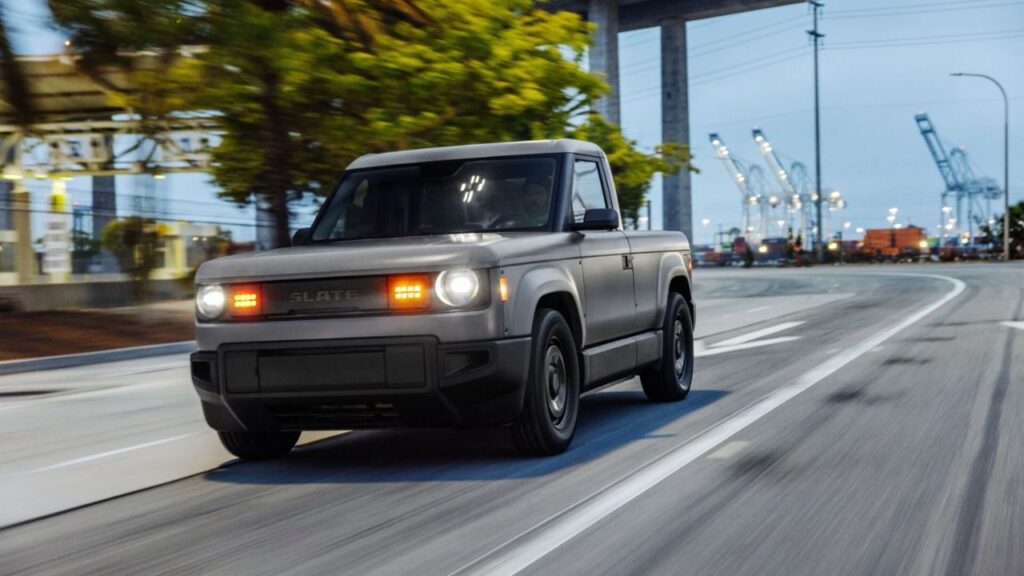
At the center of Slate’s strategy is a minimalist electric pickup truck with a starting price of $24,950. The two-seat vehicle is intentionally stripped down, featuring manual crank windows and optional speakers. Customers seeking additional functionality can convert the truck into a five-passenger SUV through a modular upgrade package priced at around $5,000.
The vehicle offers an estimated driving range of 205 miles, 181 horsepower, and 195 pound-feet of torque. While those specifications are modest compared with premium electric trucks and SUVs, they align with the vehicle’s affordability-focused positioning.
Slate first emerged from stealth mode in April 2025 when it unveiled the vehicle concept. At the time, the company promoted a starting price below $20,000, a figure that included federal EV tax incentives that have since been discontinued.
Investor confidence in the startup remains strong. Slate has raised more than $1.3 billion across three funding rounds. Two of those rounds were led by Mark Walter’s investment firm TWG Global, following an initial funding round associated with Bezos-backed investors.
The company is also seeing encouraging customer interest. Slate has secured more than 180,000 vehicle reservations, each supported by a refundable deposit. It has now begun accepting formal preorders that require a nonrefundable down payment.
Company executives expect the SUV version to account for roughly 60 percent of total sales despite the pickup serving as the base model. The pricing remains significantly below the average cost of a new vehicle in the United States, giving Slate a potential advantage among budget-conscious consumers.
A major differentiator for Slate is its modular vehicle architecture. Every vehicle will leave the factory in the same basic configuration, reducing manufacturing complexity and costs. Customers can then personalize their vehicles with a wide range of accessories and body modifications.
The company’s vehicles feature injection-molded composite body panels instead of traditional painted metal surfaces. By eliminating the need for a paint shop—one of the most expensive investments in automotive manufacturing—Slate expects to reduce production costs significantly.
Customers will be able to choose from more than 100 vinyl wrap colors and designs, many priced below $500. Additionally, over 175 accessories will be available at launch, including roof racks, lighting packages, audio systems, and exterior styling enhancements.
Unlike many modern vehicles, Slate’s EVs will not include large infotainment screens or built-in connectivity systems. Instead, drivers can use their own smartphones or tablets for navigation, entertainment, and communication.
The company plans to sell vehicles directly to consumers rather than through traditional dealerships, a strategy similar to those adopted by Tesla and Rivian. Faricy believes the direct-sales approach will help reduce costs while providing better control over the customer experience.
As Slate prepares to begin regular production operations later this year, the company still faces challenges, including vehicle certification, growing competition, and uncertain demand in the broader EV market. Nevertheless, executives remain confident that their combination of affordability, simplicity, and customization can carve out a unique position in the rapidly evolving automotive industry.|
Also Read: Record May Auto Sales Signal Strong Consumer Demand Across India

Author: Shivam
Shivam Dwivedi is a senior journalist with extensive experience in research-driven journalism, policy communication, and multi-platform storytelling. His areas of interest include international relations, defence, science & technology, education, urban development, agriculture, spirituality, and environmental sustainability. His work focuses on in-depth analysis, public discourse, and impactful narratives across governance and development sectors, with a strong commitment to the Sustainable Development Goals (SDGs). Contact: [email protected]