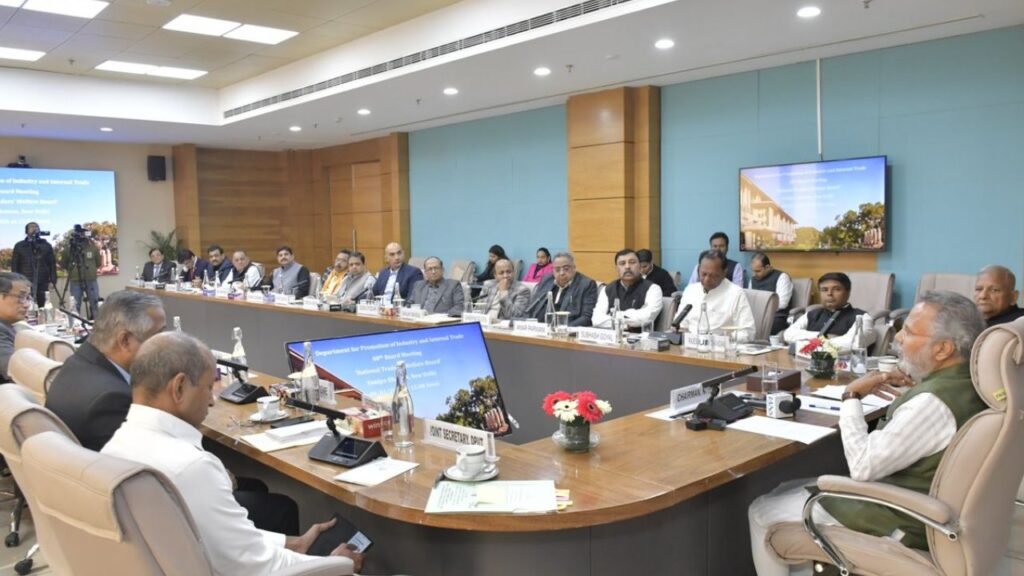

The 10th meeting of the National Traders’ Welfare Board (NTWB) was held in New Delhi on Wednesday in a hybrid format, bringing together board members, trade representatives, and government officials from across the country. The meeting focused on strengthening trader welfare, promoting digital commerce, improving ease of doing business, and enhancing India’s competitiveness in domestic and international trade.
The hybrid mode enabled participants to join both physically and virtually, reflecting the government’s emphasis on technology-driven governance and efficient use of public resources. Officials highlighted that the format encouraged broader participation while showcasing the impact of Digital India initiatives in improving stakeholder engagement and decision-making.
During the meeting, members reviewed a range of trader welfare and trade facilitation measures being implemented nationwide. Discussions included efforts to improve awareness and accessibility of various central and state government schemes designed to support traders, retailers, manufacturers, exporters, and service providers.
A key highlight of the meeting was a presentation on DigiDukaan, a digital commerce platform aimed at helping small retailers and kirana stores become active participants in the digital economy. Board members noted the successful launch of the initiative in Jaipur on June 19, 2026, and welcomed the positive response received from traders. Plans to expand the platform to major metropolitan cities such as Mumbai and Bengaluru before a nationwide rollout were also discussed.
The Board was informed about ongoing initiatives to strengthen coordination among trade associations, chambers of commerce, and trader organizations. Chairperson Sunil J. Singhi stated that 92 weekly virtual interactions and stakeholder consultations had been conducted so far, helping establish regular communication between traders and officials from different ministries and departments.
Members deliberated on a wide range of issues affecting the trading community. These included GST rationalisation, simplification of compliance requirements, one-time settlement mechanisms for legacy business liabilities, export promotion strategies, and improvements in logistics and port infrastructure. Discussions also covered import facilitation, plant quarantine procedures, affordable credit access, banking-related concerns, merchant transaction charges, and measures to strengthen social security and pension coverage for traders.
The meeting also addressed challenges related to food safety compliance, licensing procedures, and registration requirements. Participants emphasized the need to strengthen State Traders’ Welfare Boards and improve cooperation between the Centre and states to ensure effective implementation of trader-focused policies.
Concerns surrounding the rapid growth of quick-commerce platforms were raised during the discussions, with members stressing the importance of creating a balanced business environment that supports both traditional retailers and emerging digital models. The Board also explored opportunities to promote local trade ecosystems and simplify dispute resolution and appellate mechanisms for businesses.
Special attention was given to enhancing export participation among traders and micro, small, and medium enterprises (MSMEs). Members stressed the need to increase awareness of global market opportunities, strengthen institutional support systems, and create a conducive environment for export-led growth. The discussions aligned with the broader objective of positioning India as a globally competitive trading nation.
The Board further proposed the formation of thematic committees and sector-specific working groups to examine emerging challenges and provide structured policy recommendations. Members agreed that continuous stakeholder engagement would play a critical role in addressing industry concerns and ensuring timely policy interventions.
At the beginning of the meeting, the Board adopted a resolution congratulating Prime Minister Narendra Modi on becoming the longest-serving elected Prime Minister in India’s history. The resolution acknowledged his more than 12 years of service as Head of Government and highlighted his contributions to governance reforms, economic development, national security, and the vision of Viksit Bharat.
Addressing the gathering, Chairperson Sunil J. Singhi highlighted major reforms introduced over the past decade, including GST implementation, digital governance initiatives, financial inclusion through the Jan Dhan-Aadhaar-Mobile (JAM) framework, Direct Benefit Transfer (DBT) mechanisms, and various ease-of-doing-business measures. He noted that these initiatives had strengthened India’s economic ecosystem and created new opportunities for entrepreneurs and traders.
The meeting concluded with a renewed commitment to promoting trader welfare through policy advocacy, digital empowerment, social security measures, and stronger Centre-State coordination, while contributing to the national goal of building a developed India by 2047.
Also Read: India Hosts National Workshop on Environment-Related Trade Measures and WTO Framework

Author: Shivam
Proficient Writer Contact: [email protected]