
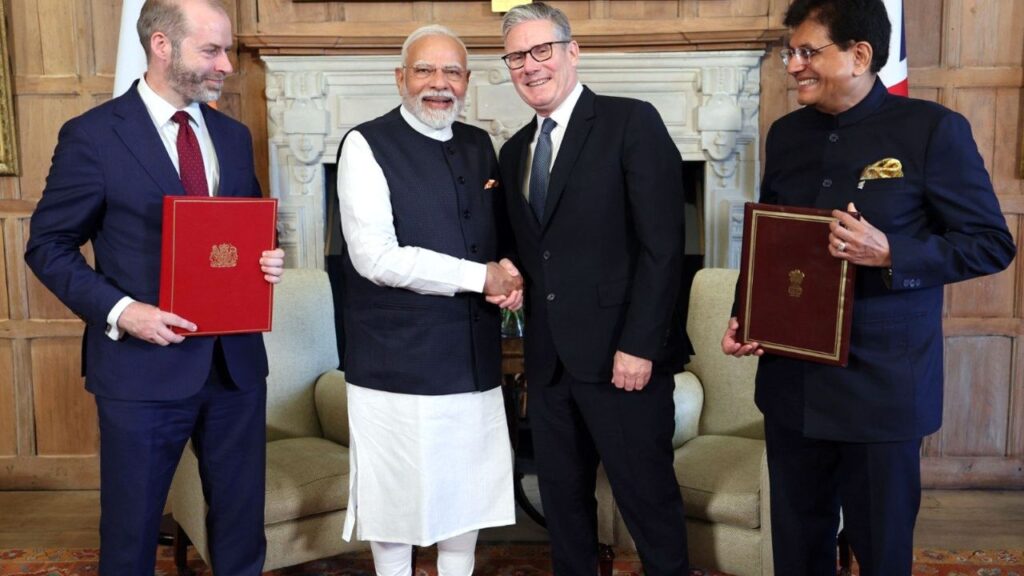

India and the United Kingdom have announced that their landmark Comprehensive Economic and Trade Agreement (CETA) and the accompanying Agreement on Social Security, known as the Double Contribution Convention (DCC), will come into force on July 15, 2026. The move marks a significant milestone in bilateral economic relations and is expected to strengthen trade, investment, and professional mobility between the two nations.
The implementation follows the completion of all necessary ratification procedures by both governments. Officials described the agreements as a major step toward deepening the India-UK Comprehensive Strategic Partnership and supporting India’s long-term vision of becoming a developed economy under the “Viksit Bharat 2047” roadmap.
The foundation for the trade pact was laid in 2021 through the India-UK Enhanced Trade Partnership and the Roadmap 2030 initiative, which aimed to expand bilateral trade and economic cooperation. After 14 rounds of negotiations, the trade agreement was concluded in May 2025 and formally signed in London in July 2025. The social security pact was signed in February 2026, completing the framework for enhanced economic engagement.
A key feature of the agreement is the removal of tariffs on 99 percent of Indian tariff lines entering the UK market. This is expected to provide a major boost to sectors such as textiles, apparel, leather, footwear, marine products, engineering goods, auto components, chemicals, pharmaceuticals, and processed food products.
Indian exporters will gain duty-free access to the UK market, eliminating tariffs that previously reached as high as 70 percent on certain processed foods, over 20 percent on marine products, and double-digit rates on several manufacturing sectors. Industry experts believe the move will improve the competitiveness of Indian products and create new opportunities for businesses, farmers, fishermen, and micro, small and medium enterprises (MSMEs).
At the same time, India has safeguarded sensitive domestic sectors by excluding products such as dairy, cereals, millets, edible oils, oilseeds, apples, and selected vegetables from tariff concessions, ensuring protection for local producers and rural livelihoods.
Beyond goods trade, the agreement includes one of the most comprehensive services packages ever offered by the UK. Covering 137 sub-sectors, it provides enhanced market access and regulatory certainty for Indian service providers in information technology, financial services, healthcare, education, engineering, telecommunications, consulting, and other professional services.
The pact also creates clearer mobility pathways for business visitors, investors, intra-corporate transferees, contractual service suppliers, and independent professionals. In a unique provision, the UK will offer dedicated annual mobility opportunities for 1,800 Indian chefs, yoga instructors, and classical musicians.
The accompanying Double Contribution Convention is being viewed as a major gain for Indian professionals working temporarily in the UK. Under the arrangement, Indian employees and employers will no longer be required to make dual social security contributions during temporary assignments. Importantly, the exemption period has been extended from three years to five years, reducing financial burdens and improving overseas employment prospects.
Government estimates suggest that more than 75,000 Indian professionals and over 900 companies are likely to benefit from the social security agreement. The measure is expected to support talent mobility and strengthen collaboration in knowledge-intensive sectors.
The two countries have also reached an understanding on steel trade, ensuring that Indian exporters remain protected from the impact of upcoming UK steel measures. According to officials, 85 percent of India’s steel exports will remain outside the scope of the new restrictions, while additional safeguards have been incorporated for affected product lines.
Officials emphasized that the agreement has been designed to deliver broad-based benefits across society by supporting farmers, workers, entrepreneurs, startups, women-led enterprises, and skilled professionals. With its focus on trade expansion, investment, innovation, and talent mobility, the India-UK CETA is expected to usher in a new era of economic cooperation and reinforce India’s position in global value chains.
Also Read: France Eyes Stronger MSME Partnerships with India, Focuses on Healthcare, Retail and Logistics

Author: Shivam
Proficient Writer Contact: [email protected]