
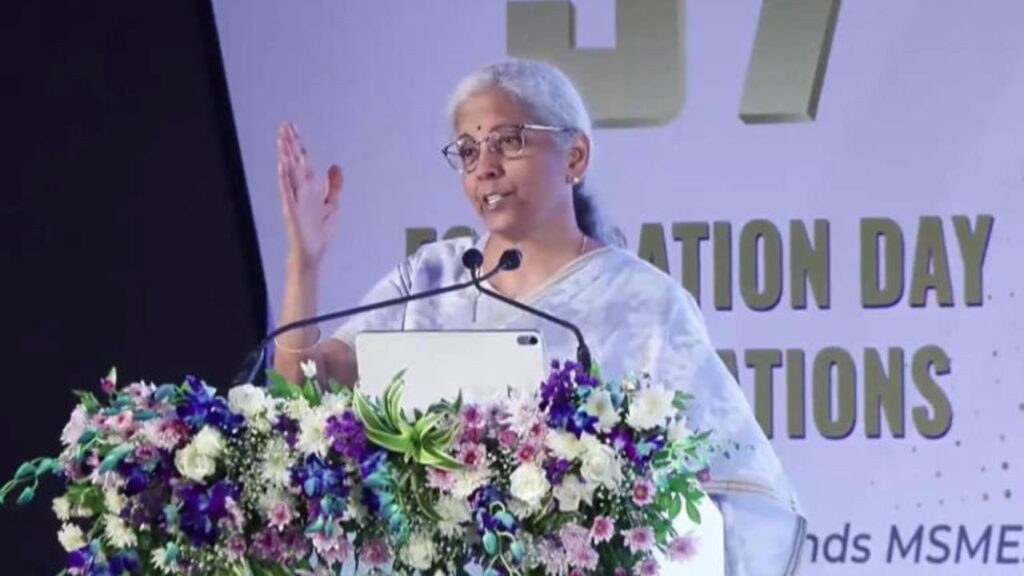

Union Finance Minister Nirmala Sitharaman on Monday emphasized the need for India to closely monitor the “3Fs” — fuel, fertiliser, and forex — in the wake of rising global economic uncertainties triggered by the ongoing West Asia crisis. Addressing an event marking the 37th anniversary of Small Industries Development Bank of India in New Delhi, the Finance Minister asserted that despite external pressures, the Indian economy continues to remain strong and resilient.
Highlighting the economic challenges arising from global geopolitical tensions, Sitharaman said the surge in crude oil and fertiliser prices is putting pressure on many economies, including India. She noted that international fertiliser prices have reached “unimaginable” levels, while rising gold prices are also creating challenges on the external sector front. According to her, these developments make it essential for policymakers to remain focused on the three critical areas of fuel, fertiliser, and foreign exchange reserves.
The Finance Minister explained that the government’s economic response has been carefully calibrated to protect domestic growth and reduce the burden on citizens. She pointed out that the Centre’s decision to cut excise duties on petrol and diesel would lead to a revenue loss of nearly ₹1 lakh crore, but stressed that the move was necessary to shield consumers from the impact of soaring global crude prices.
Sitharaman also defended the government’s economic management against criticism from what she termed as “naysayers.” Referring to recent appeals made by Prime Minister Narendra Modi encouraging collective responsibility and public participation during challenging times, she said some critics have attempted to create a pessimistic narrative suggesting that the economy is collapsing.
She argued that such fear-driven narratives overlook the positive contributions being made by ordinary citizens and various sectors of the economy. According to the Finance Minister, India cannot afford unnecessary panic or fearmongering at a time when confidence and stability are crucial for sustaining growth.
“We should appreciate that many of the current challenges are externally driven,” Sitharaman said during her address. She added that India’s domestic economic fundamentals remain positive despite the turbulence in global markets. The Minister stressed that responsible communication and constructive action are necessary to maintain public confidence.
The Finance Minister further noted that India has shown resilience even amid multiple global disruptions over the past few years, including the pandemic, supply chain disruptions, geopolitical conflicts, and inflationary pressures. She reiterated that the government remains committed to maintaining macroeconomic stability while continuing growth-oriented reforms.
During her speech, Sitharaman also raised concerns about delayed payments to micro, small, and medium enterprises (MSMEs). She revealed that nearly ₹8.1 lakh crore remains locked in pending payments owed to MSMEs, significantly affecting their working capital, production capacity, and expansion plans.
Calling the issue a serious challenge for the MSME sector, the Finance Minister urged public sector undertakings and large institutions to strictly adhere to the mandatory 45-day payment timeline for dues owed to small businesses. She emphasized that timely payments are critical for sustaining the growth and financial health of MSMEs, which play a vital role in employment generation and economic development.
The MSME sector is widely regarded as the backbone of India’s economy, contributing substantially to manufacturing output, exports, and job creation. Sitharaman stated that improving liquidity flow to small businesses would strengthen the broader economic ecosystem and support India’s long-term growth ambitions.
The Finance Minister’s remarks come at a time when governments worldwide are grappling with inflationary pressures, rising commodity prices, and geopolitical instability. Her address underscored the government’s confidence in India’s economic resilience while acknowledging the need for vigilance and proactive policy measures to navigate external challenges.

Author: Shivam
Proficient Writer Contact: [email protected]