
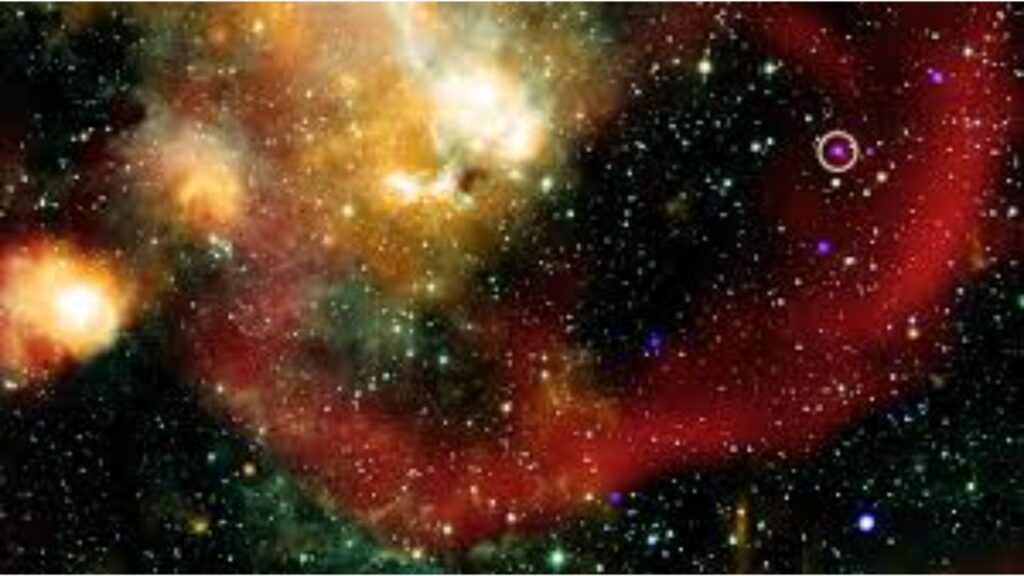

An international team of astronomers has shed light on the origin of a rare and mysterious cosmic phenomenon known as a Fast X-ray Transient (FXT), providing fresh insights into some of the most energetic events in the universe. The study, led by researchers from the Indian Institute of Astrophysics (IIA), suggests that the unusual X-ray flash was likely produced by a gamma-ray-burst-like explosion resulting either from the collapse of a massive star or the merger of two neutron stars.
Fast X-ray Transients are brief but intense flashes of low-energy X-rays that appear suddenly in the sky and fade within minutes to hours. Since their discovery about a decade ago, these short-lived events have puzzled astronomers because their fleeting nature makes them difficult to observe and understand.
The latest breakthrough centers on an FXT event designated EP241107a, detected on November 7, 2024, by the Einstein Probe, a Chinese space mission dedicated to monitoring the dynamic high-energy universe. The mission has emerged as a valuable tool for identifying and tracking transient cosmic phenomena that would otherwise remain unnoticed.
The research was led by Deepak Eappachen and Arvind Balasubramanian, both postdoctoral fellows at the Indian Institute of Astrophysics, an autonomous institution under the Department of Science and Technology (DST). By combining observations across multiple wavelengths, the team was able to investigate the event in unprecedented detail.
One of the key findings came from the detection of a radio counterpart to the X-ray flash using the Karl G. Jansky Very Large Array (VLA) in New Mexico, USA. The radio observations provided critical evidence that helped scientists trace the physical processes behind the explosion.
To support the study, researchers also utilized several major observatories in India. Optical observations were conducted using the Himalayan Chandra Telescope (HCT) and the GROWTH India Telescope (GIT) at the Indian Astronomical Observatory in Hanle, Ladakh. These facilities monitored the transient event under the region’s exceptionally clear skies. Additional observations were carried out using the Upgraded Giant Metrewave Radio Telescope (uGMRT), operated by the National Centre for Radio Astrophysics.
The international collaboration also involved observations from some of the world’s leading astronomical facilities, including the 10-metre Keck Observatory in Hawaii and the Southern Astrophysical Research (SOAR) Telescope in Chile.
By comparing the optical and radio signatures of EP241107a with those of other known extragalactic transient events, researchers found strong evidence linking the flash to a gamma-ray-burst-like explosion. Analysis of the host galaxy and the event’s afterglow further strengthened this conclusion.
Detailed modeling revealed that the explosion generated a highly energetic jet. The kinetic energy carried by this jet was estimated to be comparable to the total energy emitted by all the stars in the Milky Way over several months, assuming the energy was released uniformly in every direction. Such enormous energy levels place the event among the most extreme cosmic explosions known.
The study suggests that EP241107a may represent an “orphan afterglow” — a rare phenomenon in which the afterglow of a gamma-ray burst is detected even though the original gamma rays are not directly observed. Scientists believe this can occur when the burst is not pointed directly toward Earth, making the gamma rays difficult to detect while leaving behind observable emissions at other wavelengths.
Researchers note that the event could belong to the lower-energy end of the gamma-ray burst population, offering valuable clues about a class of explosions that remains poorly understood.
The findings not only improve understanding of Fast X-ray Transients but also provide important insights into the physics of stellar collapse, neutron star mergers, and the formation of powerful cosmic jets. As more such events are detected through advanced space missions and ground-based observatories, astronomers hope to unravel the mysteries of some of the universe’s most dramatic and energetic phenomena.
The study has been published in the journal Monthly Notices of the Royal Astronomical Society and involved researchers from India, the United States, and several leading international institutions.