
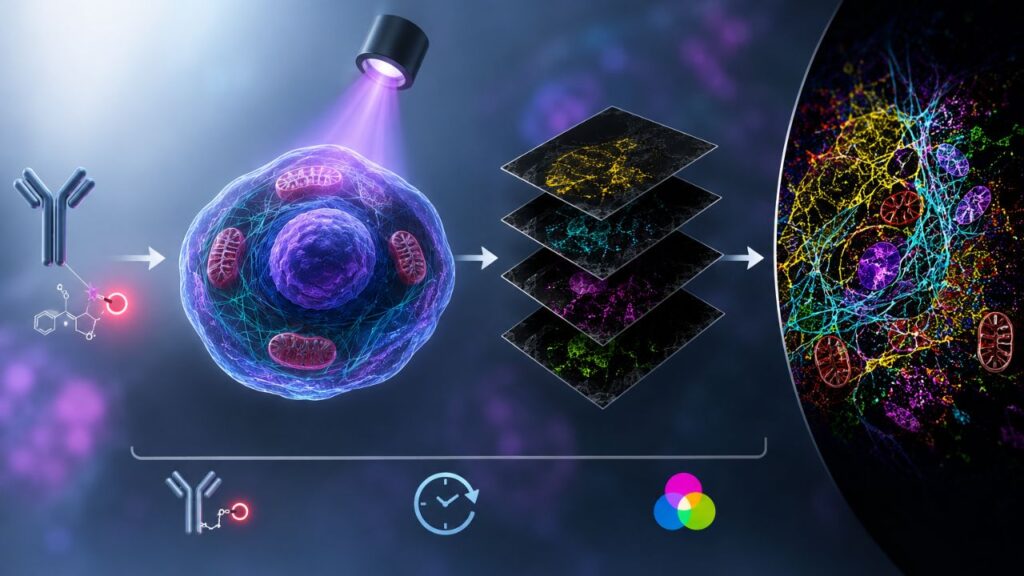

A groundbreaking imaging technology developed by Indian researchers could significantly advance the way scientists study diseases at the cellular level. The new platform, called Cleavable Light-Erased Antibody Reporter (CLEAR), enables researchers to visualize an exceptionally large number of proteins within a single biological sample using only one fluorescent marker. The innovation is expected to accelerate progress in cancer diagnosis, immunology, neuroscience, and precision medicine.
Proteins play a central role in almost every biological process and are among the most important indicators used in disease diagnosis and drug development. Understanding where proteins are located and how they interact inside tissues is essential for decoding complex diseases. However, existing imaging techniques often face limitations in the number of proteins they can simultaneously observe within the same sample.
To address this challenge, researchers at the Jawaharlal Nehru Centre for Advanced Scientific Research developed the CLEAR platform, a next-generation imaging system capable of repeatedly labeling and imaging proteins in the same specimen without damaging the biological sample.
The research team was led by Prof. Sarit S. Agasti. The scientists designed specialized light-cleavable probes that allow fluorescent signals to be erased after imaging, making space for new rounds of protein labeling and visualization.
The technology functions much like a reusable chalkboard. Scientists first label a selected group of proteins using fluorescent tags and capture images under a microscope. Once imaging is completed, a gentle pulse of 365 nm LED light removes the fluorescent signal without harming the sample. Researchers can then introduce a new set of probes and repeat the imaging process within the same optical window.
By repeating this cycle multiple times, the platform can generate highly detailed maps of proteins across cells and tissues. This iterative imaging strategy enables virtually unlimited protein visualization while using only a single fluorophore, overcoming one of the major bottlenecks in multiplexed imaging.
The CLEAR platform was developed at JNCASR, an autonomous institute under the Department of Science and Technology. Collaborative efforts with researchers from the Indian Institute of Science helped demonstrate the technology’s effectiveness in complex biological systems, particularly immune cell environments.
According to the researchers, the platform combines several major advantages that existing imaging systems struggle to achieve simultaneously. These include high multiplexing capability, rapid imaging cycles, superior spatial resolution, and compatibility with fragile biological samples, including live cells.
The study detailing the innovation was published in the scientific journal Royal Society of Chemistry’s journal Chemical Science. The findings highlight how the CLEAR system can provide comprehensive molecular insights while preserving the native architecture of tissues and cells.
Experts believe the technology could have far-reaching applications in biomedical research and clinical diagnostics. In cancer biology, for example, detailed protein maps could help pathologists identify tumor characteristics with greater precision and detect disease at earlier stages. In neuroscience, the method may improve understanding of protein interactions linked to neurological disorders such as Alzheimer’s and Parkinson’s disease.
The platform could also play a major role in immunology research by helping scientists observe how immune cells communicate and respond during infections or inflammatory conditions. Such insights may support the development of more targeted therapies and personalized treatment strategies.
In the long term, CLEAR aligns closely with global efforts in spatial proteomics and precision medicine, areas that focus on understanding diseases at the molecular level to create individualized healthcare solutions. By enabling deeper visualization of protein organization inside tissues, the technology could contribute to more accurate diagnostics and better therapeutic outcomes.
The development of CLEAR marks a significant achievement for Indian scientific research and demonstrates the growing contribution of the country’s institutions to advanced biomedical innovation.

Author: Shivam
Proficient Writer Contact: [email protected]