
India’s space economy is expected to witness a remarkable expansion over the next ten years, growing from its current valuation of around USD 8–9 billion to nearly USD 40–45 billion, Union Minister of State (Independent Charge) for Science and Technology and Earth Sciences, Dr Jitendra Singh, said on Monday. He attributed this anticipated growth to policy reforms, increased private sector participation, and a rapidly evolving innovation ecosystem.
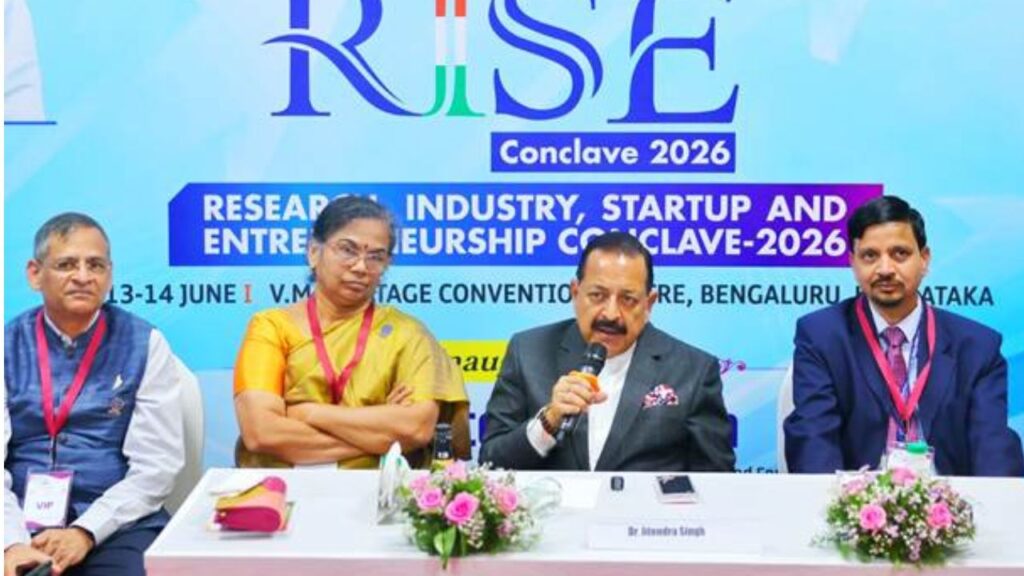
Addressing a press conference during the RISE Conclave 2026, Dr Jitendra Singh highlighted the transformative journey of India’s space sector and its growing role in shaping the country’s economic and technological future. He noted that science and technology have moved beyond research laboratories and become an integral part of public discourse and national development.
According to the Minister, one of the most significant achievements in recent years has been the growing engagement of ordinary citizens with scientific progress. He observed that people increasingly view themselves as stakeholders in India’s scientific achievements, creating a stronger connection between science and society.
Dr Jitendra Singh credited Prime Minister Narendra Modi’s vision for bringing science-led initiatives into the national mainstream. Programmes such as Swachh Bharat, Digital India, Digital Health, Deep Ocean Mission, and Gaganyaan have helped place innovation and technology at the heart of India’s development agenda. He added that the increased presence of mainstream media at scientific events reflects rising public interest in technological advancements.
The Minister said landmark missions such as Chandrayaan-3 have significantly boosted awareness about space science among citizens. These achievements, he noted, have transformed space exploration from a specialised subject into a matter of national pride and widespread public interest.
Highlighting India’s growing global stature, Dr Jitendra Singh said the country’s achievements in areas such as space technology, atomic energy, and advanced scientific research have enhanced international confidence in indigenous technologies. This growing recognition has strengthened India’s reputation as a reliable technology partner on the global stage.
He pointed out that reforms in the space sector have encouraged unprecedented private sector participation. While India had only a few space startups a few years ago, the number has now crossed 400, creating a vibrant ecosystem that is driving innovation, investment, and entrepreneurship. The rapid growth of these startups demonstrates the immense potential of India’s emerging space economy, he said.
Dr Jitendra Singh also underscored India’s success in executing complex space missions efficiently and cost-effectively. Missions such as Chandrayaan-3 and the upcoming Gaganyaan human spaceflight programme have reinforced India’s position among the world’s leading space-faring nations.
A distinctive strength of India’s space programme, according to the Minister, is its extensive application of space technology for governance and development. He explained that satellite-based tools are being widely used for infrastructure planning, project monitoring, urban development, and public service delivery. Initiatives such as PM Gati Shakti and drone-enabled monitoring systems are helping improve transparency, efficiency, and decision-making across sectors.
Addressing concerns related to recent challenges in space missions, Dr Jitendra Singh emphasized that scientific progress is built on continuous learning and improvement. He stated that every mission contributes valuable insights that help strengthen future programmes. Referring to the recent PSLV mission anomaly, he said a detailed analysis had been completed, the root causes identified, and corrective measures initiated to prevent similar issues in future launches.
The Minister stressed that India’s overall record in space exploration remains highly impressive, citing the successful first-attempt achievements of the Chandrayaan and Mars Orbiter missions as evidence of the country’s scientific capabilities.
Speaking about the broader innovation landscape, Dr Jitendra Singh said scientific achievements are increasingly contributing to economic growth, self-reliance, and global competitiveness. The active participation of startups, industries, investors, and research institutions is helping build a strong innovation ecosystem aligned with the vision of Viksit Bharat 2047.
The RISE Conclave 2026, organised under the theme “Innovation & Entrepreneurship Driven Growth for Viksit Bharat 2047,” brought together researchers, policymakers, industry leaders, investors, and entrepreneurs. More than 125 startups and technology innovators showcased solutions in aerospace, artificial intelligence, deep technology, and agri-food innovation, while discussions focused on strengthening research-industry collaboration and accelerating innovation-led growth across the country.
Also Read: Haryana Partners with CSIR-CRRI to Launch Urban Road Greening Project for Cleaner NCR Air